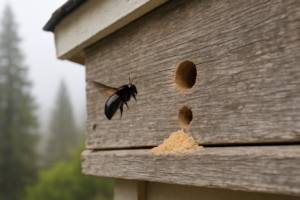
Direct Answer: Carpenter bees bore round, half-inch holes into weathered wood on eaves, fascia, decks, and fences. They reuse and extend those tunnels each year, so damage builds quietly over time.
Every spring I get calls that start the same way. A homeowner sees a big black bee hovering near the porch, hears a low buzzing along the eaves, and figures it is a bumblebee doing bumblebee things.
Most of the time it is not. It is a carpenter bee, and while it is not going to chase anyone down the driveway, it is drilling into the wood on your house.
That is the part people miss. Carpenter bees are a damage problem, not a stinging problem, and in Santa Cruz County’s older wood homes that damage adds up quietly over several seasons.
What Carpenter Bees Actually Do to Wood
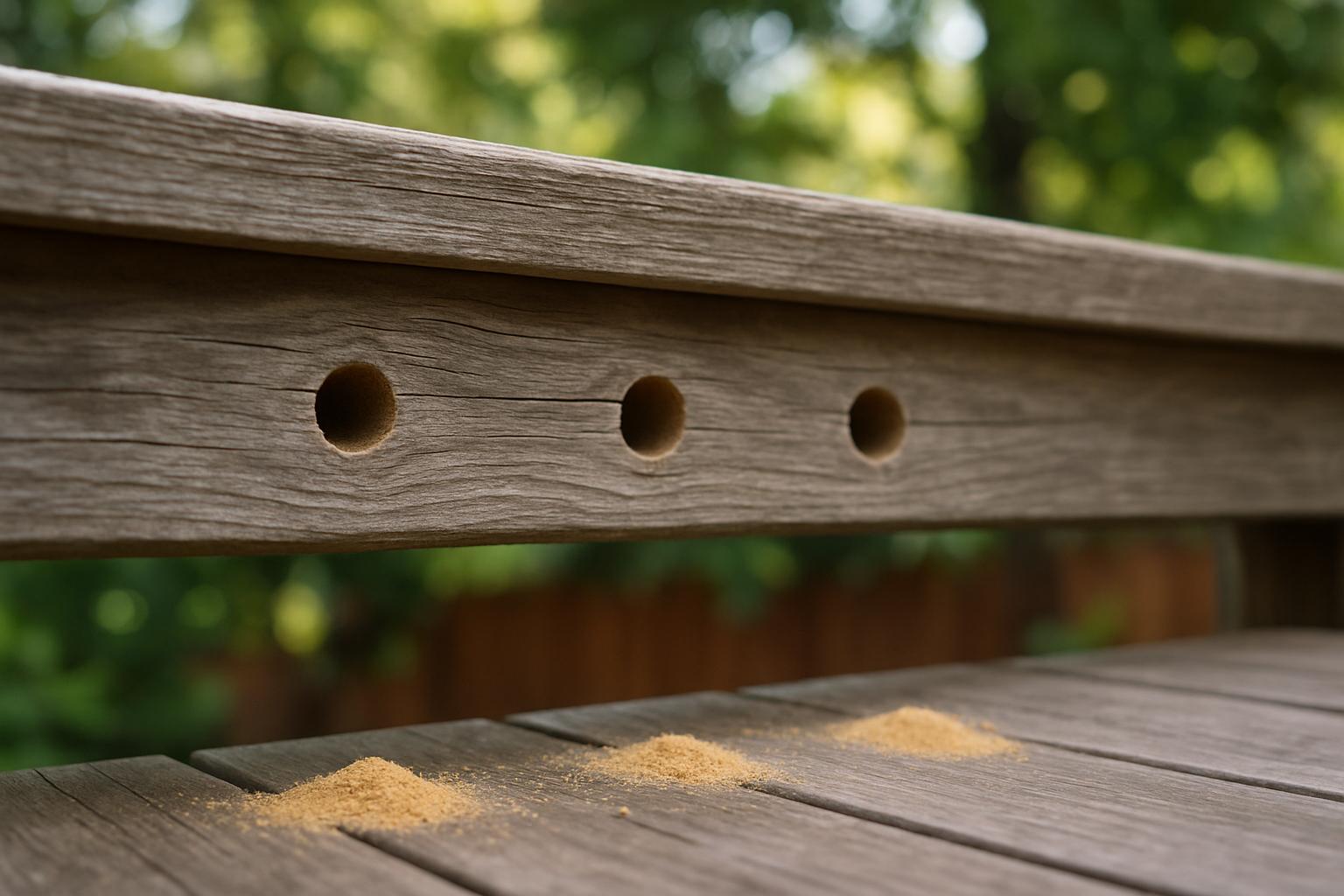
The female does the work. She bores a hole that looks almost machine-drilled, about half an inch across, then turns and tunnels with the grain to build a nesting gallery for her eggs.
That gallery can run several inches deep, sometimes much farther in soft older wood. One hole by itself is not a structural crisis. The problem is that the same tunnel gets reused and extended year after year.
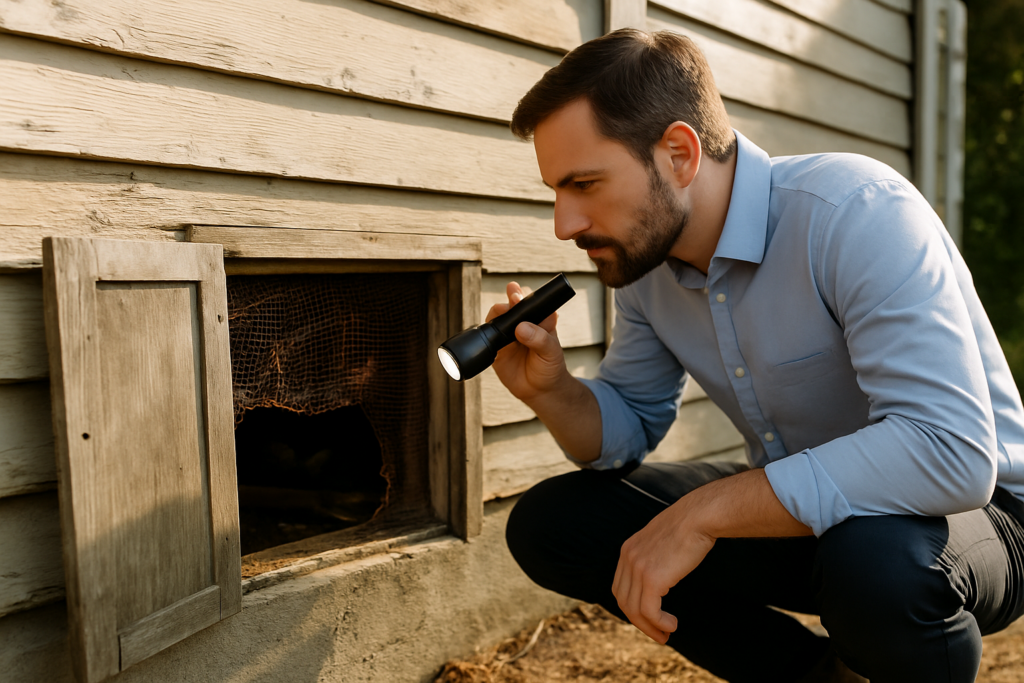
The spots I find them most often around Santa Cruz County:
- Eaves and fascia boards, especially on the sunny south and west sides
- Deck railings and the underside of deck framing
- Window and door trim where the paint has failed
- Wood fencing, particularly older redwood
- Exposed rafter tails and pergola beams
The University of California’s pest notes on carpenter bee biology and behavior back up what I see in the field: they favor bare, weathered, or unfinished wood over anything freshly painted.
The Bee Buzzing Your Face Cannot Sting You
This is the single most useful thing I explain on carpenter bee calls, and it settles people down fast.
The bee that hovers in front of you, darts at your head, and generally acts like a bouncer is the male. Males have no stinger at all. They are guarding the nest area and the whole display is bluff.
The female can sting, but she is busy tunneling and almost never does unless someone grabs her or corners her. In years of doing this work, the stings I hear about come from people handling a bee directly.
So the risk math is different from a yellow jacket nest by the front door. That one I treat as urgent. Carpenter bees are more like a slow leak in the roof: not dangerous today, more expensive every month you leave it.
Why Santa Cruz County Homes Get Hit Harder
Fog is the reason. Our marine layer plus winter rain keeps exterior wood damp and cycling between wet and dry, which strips finish and grays out bare boards faster than in inland California.
Weathered wood is exactly what a female carpenter bee is shopping for. Soft, unsealed, easy to chew.
That is why the calls cluster where they do:
- Ben Lomond, Boulder Creek, and the mid-county mountain homes with redwood siding, wood decks, and heavy tree cover
- Older beach-area homes in Santa Cruz, Capitola, and Rio del Mar where salt air and fog chew through paint
- Rural Corralitos and Aptos Hills properties with barns, sheds, arbors, and long stretches of fence
Stucco homes in newer Scotts Valley or Watsonville subdivisions? Far fewer problems. When a neighbor two doors down has zero bee activity and you have six holes in your fascia, the siding usually explains it. This is the same pattern I describe in our residential pest management approach: conditions drive the pest, not luck.
Reading the Signs in Order
Carpenter bee evidence shows up in a fairly predictable sequence. Here is how to tell where you are in it.
| What You See | What It Means | What It Suggests |
|---|---|---|
| Large black bees hovering near eaves in spring | Males guarding a nesting area | Nesting is starting or already underway nearby |
| Fine sawdust piles on a deck, sill, or ground | Fresh boring debris, called frass | There is an active tunnel directly above it |
| Clean round holes about half an inch wide | Completed gallery entrances | At least one full nesting season has happened |
| Yellowish staining streaked below a hole | Waste from an occupied gallery | The tunnel is in use, not abandoned |
| Woodpecker holes or torn-up siding | Birds excavating to reach bee larvae | An established population plus secondary damage |
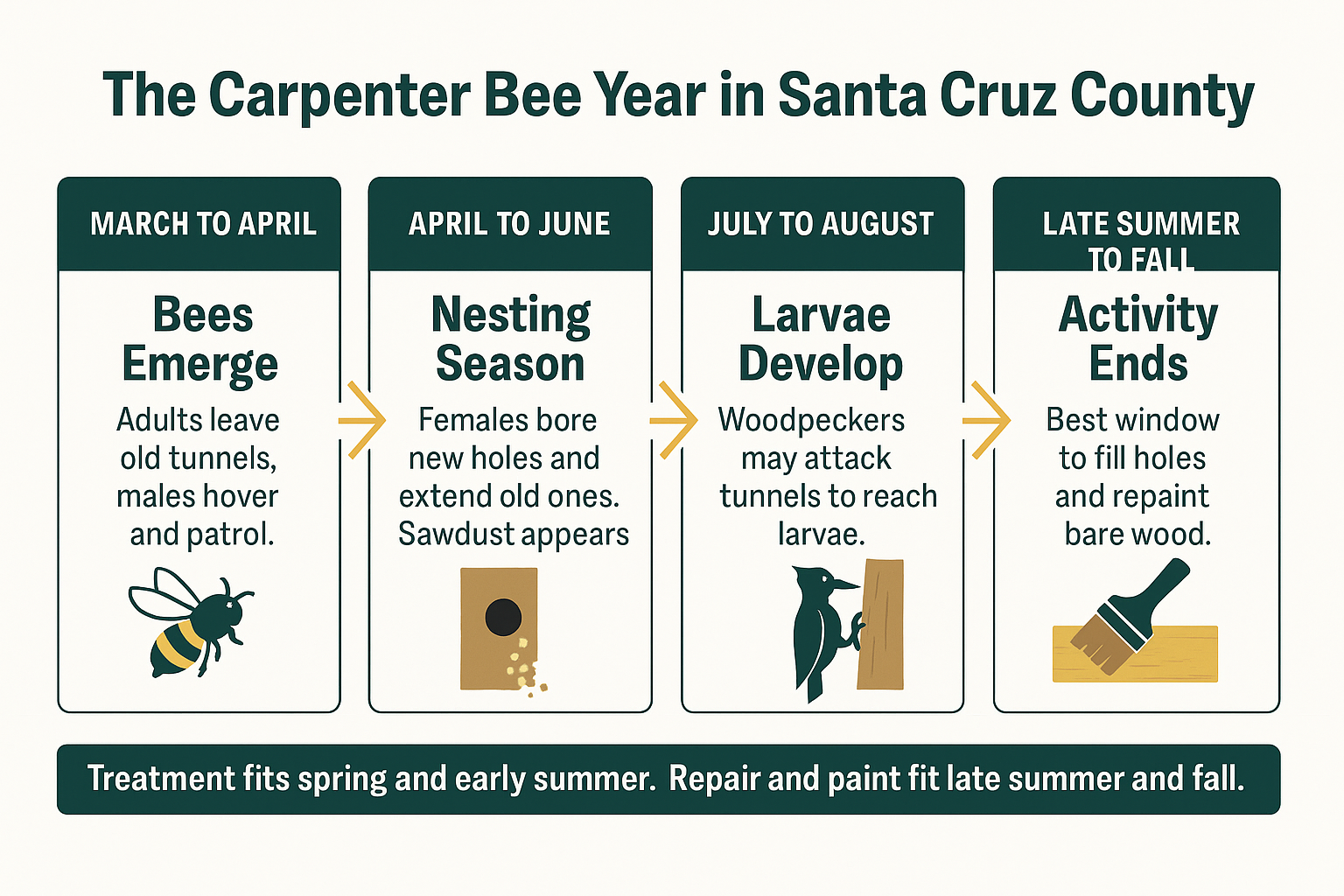
The Carpenter Bee Year on the Central Coast
Timing drives every decision here. This is roughly how the season plays out in Santa Cruz County.
Your Real Options, and When Each One Works
There are only three moves that matter, and each has a season.
1. Treat active galleries in spring and early summer. While the bees are working, the tunnels are occupied. Treating the gallery itself is what stops the current generation from finishing out.
2. Fill the holes after the season ends. Once activity stops in late summer or fall, empty tunnels can be filled with wood putty, dowels, or exterior caulk and then painted over. Filling an occupied tunnel in May usually just gets you a fresh hole a few inches away.
3. Paint or stain the bare wood. This is the highest-value thing a homeowner does. A finished surface is far less appealing than gray, peeling, or raw wood, and it protects you the following spring.
On cost, treatment pricing varies more than people expect. What drives it locally:
- How many active galleries are present and how spread out they are
- Access height, since second-story fascia and tall eaves take longer than deck rails
- Whether repair and painting are handled by you or a carpenter afterward
Many Santa Cruz County homeowners find bee work lands in the same neighborhood as other targeted exterior treatments, but the honest answer is that it depends on the house. A look at the wood gets you a real number. If you are already booking seasonal work, our guide to how often a Santa Cruz home needs a pest inspection is a reasonable place to start, and what IPM means for homes with kids and pets covers how we keep exterior treatments targeted.
Frequently Asked Questions About Carpenter Bees in Santa Cruz
Will carpenter bees cause serious structural damage to my house?
A single season of nesting rarely does. The concern is cumulative damage over years, because galleries get reused and extended, and woodpeckers tear the wood open to reach larvae. Fascia and railings are the boards I see genuinely compromised.
Is the bee dive-bombing my porch dangerous?
Almost certainly not. That is the male, and males have no stinger. Females can sting but generally only if handled.
Can I just plug the holes myself?
You can, and it is worth doing, but timing matters. Fill them in late summer or fall after activity stops, then paint over the repair. Sealing an active tunnel in spring usually results in a new entry hole beside it.
Why does my house have them and my neighbor’s doesn’t?
Usually siding and finish. Bare or weathered wood attracts them, and our coastal fog gray out redwood and unpainted trim quickly. Stucco homes with little exposed wood tend to be left alone.
Are carpenter bees pollinators I should leave alone?
They do pollinate, and I have no interest in wiping out bees for the fun of it. The approach I take is targeted at the specific galleries damaging the structure rather than blanket spraying the yard.
Not Sure If Those Holes Are Active?
If you have found round holes and sawdust on a deck or under an eave anywhere in Santa Cruz County, it is worth having someone look at the wood before another spring rolls through. West Pest Co. works throughout the county, from the Westside out to Corralitos and up into Ben Lomond, and questions are welcome at (831) 430-8402 or westpestco.com.