Direct Answer: Most spiders in Santa Cruz are harmless. The western black widow is the one to take seriously. Knowing which is which helps you decide whether to act or leave it alone.
I get spider calls year-round in Santa Cruz County — and that surprises a lot of people who assume spiders die off in winter. They don’t, not here. The county’s mild, foggy climate means spiders stay active through December and January in ways you simply wouldn’t see in Fresno or Sacramento. Older wood-frame homes on the Westside, cabins tucked into the redwood canyons above Scotts Valley, crawlspaces in Aptos — these are ideal year-round spider environments.
Most of the spiders people call about are completely harmless. But a few aren’t, and knowing the difference matters — especially if you have kids or pets and you’re trying to decide whether to act. This guide focuses on the four spiders I see most often in Santa Cruz homes: the western black widow, the cellar spider, the giant house spider, and the yellow sac spider. I’ll tell you which ones are worth worrying about and which ones you can honestly leave alone.
I’ll also cover what a real spider prevention approach looks like — because a few people have asked about quarterly preventative service specifically for spiders, and the answer is more nuanced than most expect.
The Four Spiders Santa Cruz Homeowners Actually Encounter
There are dozens of spider species in Northern California, but in the field, these four come up over and over again in Santa Cruz County homes.
Western Black Widow
This is the one that deserves real attention. Black widows are common throughout the county — garages, woodpiles, crawlspaces, utility boxes, and the undersides of outdoor furniture are all typical spots. The female is glossy black with a distinctive red hourglass marking on the underside of the abdomen. Their webs are irregular and messy, usually built low to the ground.
The venom is medically significant, particularly for children and elderly adults. That said, black widows are not aggressive — bites typically happen when someone accidentally contacts a web or reaches into a dark space without looking. I’ve found them in nearly every older crawlspace I’ve inspected in Santa Cruz, and in sheds and garages throughout Aptos and Capitola.
Yellow Sac Spider
This is the one responsible for most indoor spider bites in California, and most homeowners have no idea it exists. Yellow sac spiders are small — about the size of a pencil eraser — and pale yellow or cream-colored. They don’t build classic webs. Instead, they construct small silk retreats in corners, along ceiling edges, and behind picture frames.
Their bites are rarely serious, but they can cause local irritation and mild swelling. Because they’re so small and their retreats are easy to miss, many people dealing with unexplained nighttime bites never connect the dots.
Giant House Spider
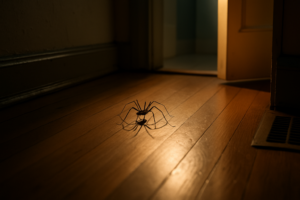
Large, fast-moving, and deeply alarming if one runs across your floor at night. Giant house spiders are the ones that cause the most panic calls — and the least concern from a safety standpoint. They’re not medically significant. They’re actually one of the more useful spiders to have around because they compete with and occasionally prey on black widows.
Cellar Spider
Commonly mistaken for daddy longlegs, cellar spiders have extremely long, thin legs and small bodies. They’re almost always found in corners, garages, basements, and crawlspaces. Completely harmless, and they actually help control other insects. I usually tell homeowners they can leave these alone unless the web accumulation is bothering them.
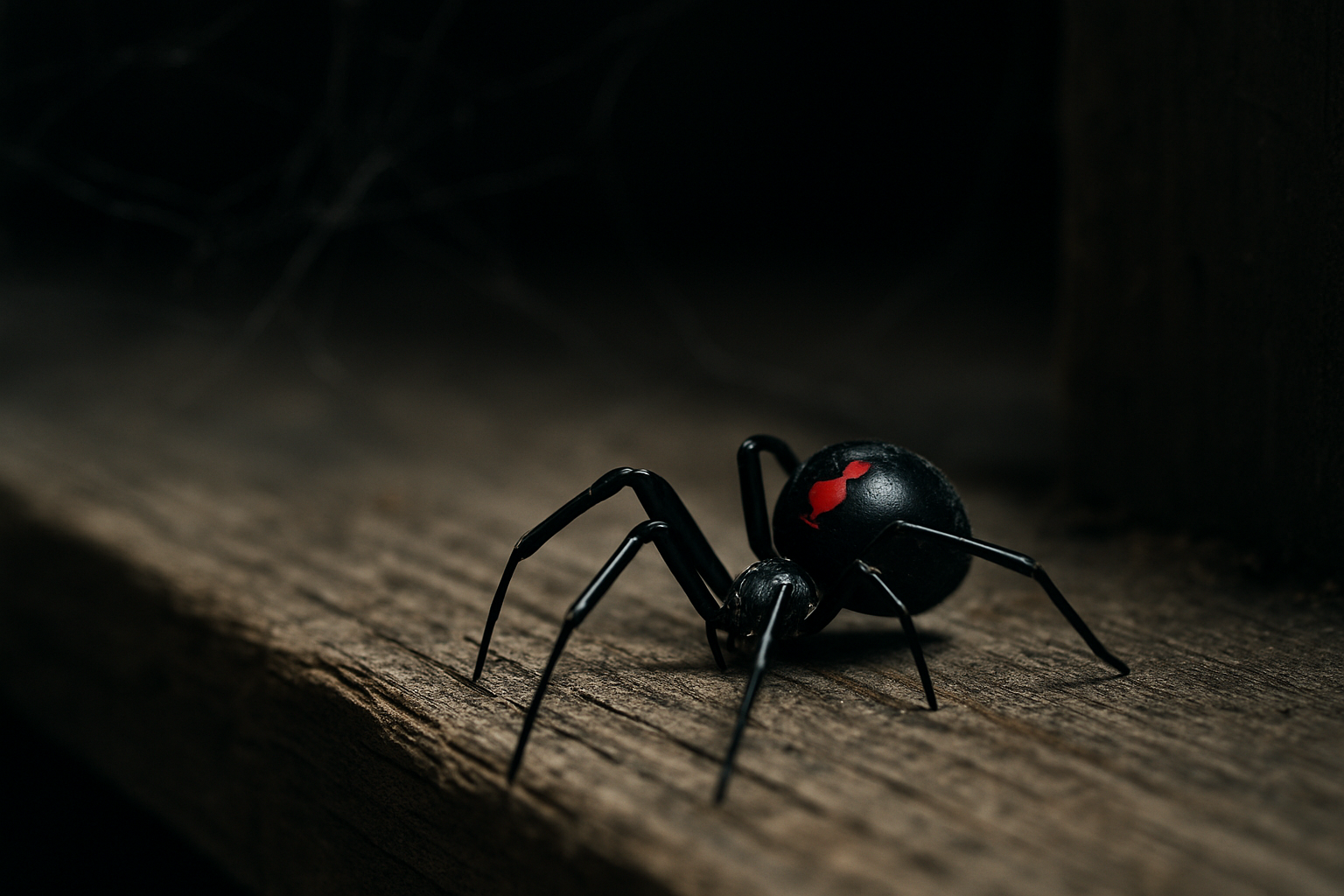
Santa Cruz Spider Quick-Reference
Here’s a simple breakdown of the four spiders covered above — what they look like, where they turn up, and how to think about each one.
| Spider | Appearance | Where I Find Them | Concern Level |
|---|---|---|---|
| Western Black Widow | Glossy black, red hourglass on underside | Crawlspaces, garages, woodpiles, sheds | Call a professional |
| Yellow Sac Spider | Small, pale yellow or cream, no visible web | Ceiling edges, corners, behind frames | Worth treating if bites occurring |
| Giant House Spider | Large, brown, fast-moving | Living areas, garages, bathtubs | Not a health concern |
| Cellar Spider | Very long thin legs, small body | Basements, crawlspaces, corners | Harmless — leave it |
Why Santa Cruz Homes See Spiders All Year — Not Just in Summer
Most of inland California gets a natural reset in winter. Cold temperatures push spiders into dormancy and knock down populations. Santa Cruz doesn’t get that reset.
The county’s coastal fog and mild temperatures — rarely dropping below the mid-40s even in January — mean spiders stay active through the cooler months. I see consistent spider activity in Ben Lomond cabins and Westside bungalows well into February. That’s genuinely different from what you’d see 40 miles inland.
Older housing stock makes this worse. Santa Cruz has a significant number of wood-frame homes built before 1970, many with unfinished crawlspaces, aging weatherstripping, and gaps around plumbing penetrations. Those gaps don’t just let in drafts — they’re the same entry points spiders and their insect prey use to move indoors.
If you’re dealing with spiders inside your home and feel like it’s a seasonal problem that never fully goes away, the coastal climate is a big part of why.
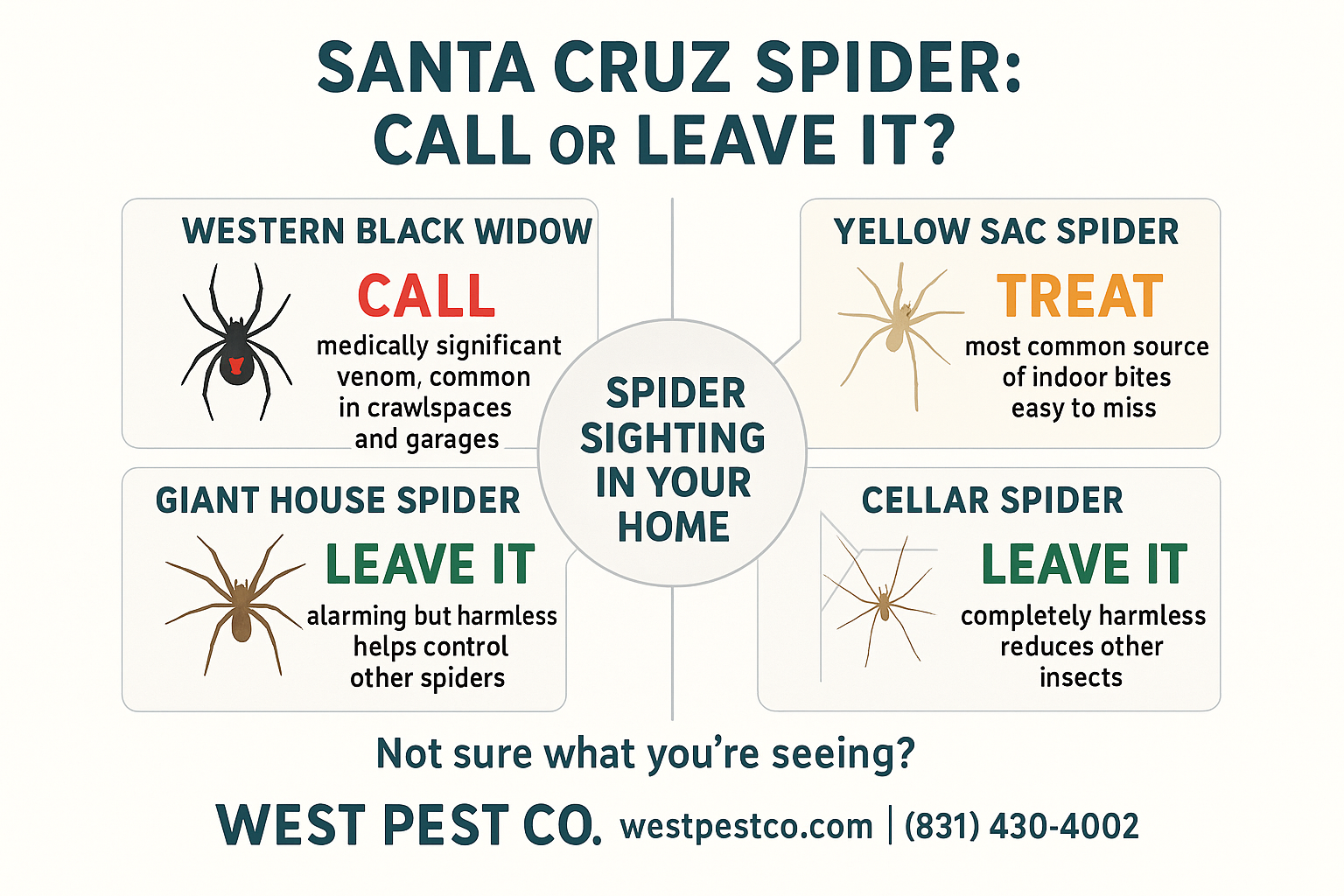
The ‘Call or Leave It’ Framework for Santa Cruz Spiders
This visual breaks down how to quickly assess a spider sighting and decide whether it warrants action.
What ‘Preventative Spider Control’ Actually Involves
A few homeowners have asked specifically about quarterly preventative service for spiders — wanting to stay ahead of the problem rather than react to it. I think that instinct is right, but it helps to understand what prevention actually addresses.
Spiders don’t come into your home because they want to live there. They follow their food. Indoor spider populations are almost always tied to the presence of other insects — flies, moths, ants, silverfish — that spiders are hunting. If you treat entry points and harborage sites without addressing the underlying insect population, you’re solving half the problem.
A real prevention approach for spiders typically involves:
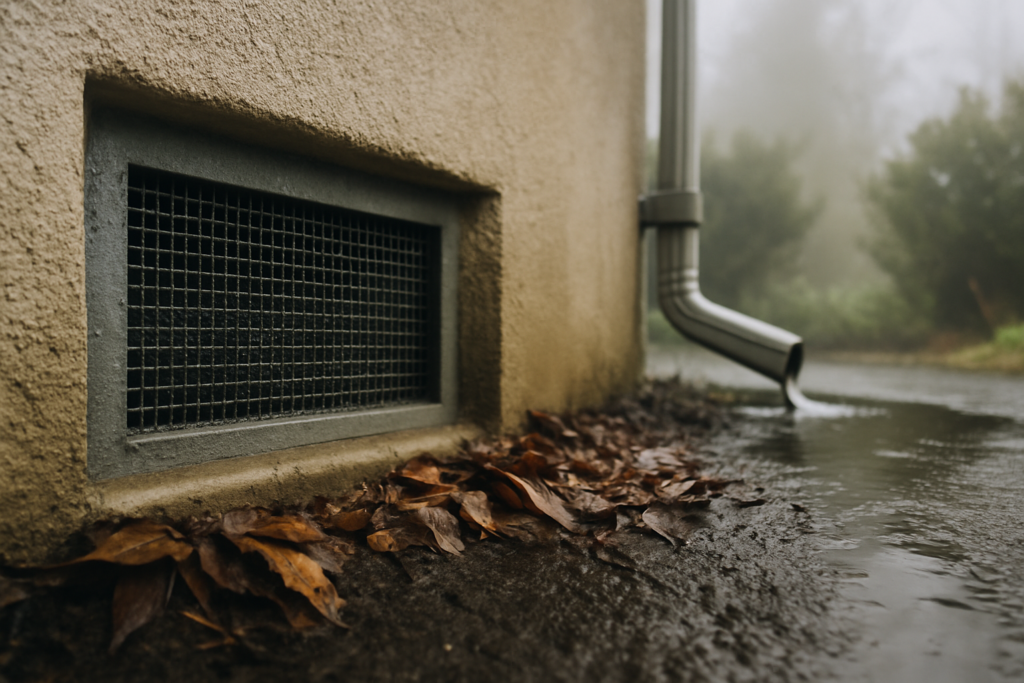
- Treating entry points — door sweeps, window gaps, plumbing penetrations, and foundation vents where spiders and insects get in
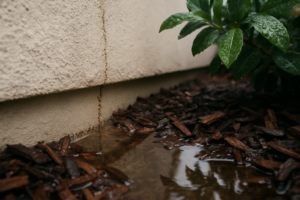
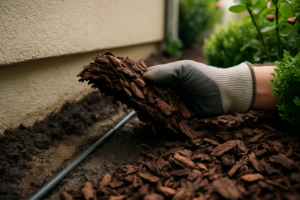
- Reducing harborage sites — clearing debris, woodpiles, and clutter from garages and around the exterior of the home
- Targeted interior and perimeter treatments focused on high-activity zones like crawlspaces, garage walls, and basement corners
- Addressing co-occurring insects that are drawing spiders in the first place
For older homes in areas like Soquel, Rio del Mar, or anywhere near the redwood belt, the harborage reduction piece is especially important — there’s simply more organic debris and more structural hiding spots for both spiders and their prey.
If you’ve been wondering when to stop handling a pest problem on your own and bring someone in, spider prevention is a good example of where the professional advantage is real — not because the job is dangerous, but because identifying what’s feeding the spider population requires knowing what to look for.
A Note on Black Widows in Crawlspaces
I want to spend a moment on black widows specifically, because they come up in nearly every inspection I do in Santa Cruz County and homeowners often underestimate how common they are.
I’ve found black widow webs in crawlspaces under homes where the family had no idea they were there — including in properties where families with young children were living. The spiders weren’t aggressive. Nobody was bitten. But the potential was real.
Crawlspaces in coastal Santa Cruz are particularly favorable for black widows: low light, high humidity from the fog, and usually plenty of insects. The combination of a damp crawlspace and a woodpile or debris pile outside is about as ideal as it gets for them.
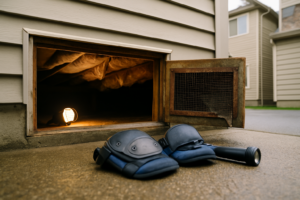
If your home has an unfinished crawlspace and it hasn’t been inspected in a while, it’s worth knowing what’s down there. A pest inspection can surface these situations before they become a concern — and that’s especially true for anyone moving into an older home or a property that’s been vacant for a while.
One homeowner moving into an older house on the Westside reached out asking specifically for a non-toxic interior treatment because of three children in the home. That’s exactly the right question to ask. There are effective, eco-friendly approaches for black widow control that don’t require broadcasting chemicals through a living space.
Frequently Asked Questions About Spiders in Santa Cruz
How do I know if what I’m seeing is actually a black widow?
The female western black widow is distinctive: glossy black, roughly pea-sized body, and a red hourglass shape on the underside of the abdomen. If you can’t see the underside, look at the web — black widow webs are irregular, low to the ground, and feel noticeably tough and sticky compared to other spiders. If you’re in a garage, crawlspace, or woodpile and you see a messy, tangled web close to the ground, treat it as a black widow until proven otherwise.
Are the spiders in my garage dangerous to my kids or dog?
Mostly no — but black widows are an exception. Giant house spiders and cellar spiders are harmless. Yellow sac spiders can cause mild irritation but aren’t dangerous to healthy adults, children, or pets in the way a black widow is. If you have a crawlspace or an older garage, it’s worth having it checked for black widows specifically. That’s the one I’d take seriously with kids and pets in the house.
Why do I keep finding spiders inside even though I’ve sprayed?
Spraying alone doesn’t address why spiders are coming in. If there’s an active insect population inside your home — flies, moths, ants, silverfish — spiders will follow. And if the entry points around your foundation, doors, and windows aren’t sealed, new spiders will keep moving in from outside. Treatment works best when it’s paired with entry point work and reducing whatever’s drawing spiders in the first place. Articles like Ants Come Back Every Summer explain the same principle for other pests — it applies to spiders too.
Is quarterly spider control actually worth it?
For some homes, yes — especially older properties near the redwood canyons, homes with unfinished crawlspaces, or any structure with a history of black widow activity. Quarterly visits allow for consistent entry point maintenance and catch harborage buildup before it gets out of hand. For a newer, well-sealed home with minimal clutter, the need is lower. The answer really depends on the specific property.
Can I identify spiders from a photo?
Sometimes, but not always reliably. Black widows are fairly easy to identify from a clear photo if the hourglass is visible. Yellow sac spiders are harder — they’re small, pale, and look similar to several harmless species. If you’re trying to figure out whether a bite came from a specific spider and can’t make a positive ID, it’s worth having someone look at the actual space rather than the photo.
Not Sure What You’re Dealing With?
If you’ve spotted something in your garage or crawlspace and you’re not sure whether it warrants a call, West Pest Co. is happy to help you figure it out. Matthew West has earned back-to-back Readers Choice Best Pest Control recognition in Santa Cruz County and maintains a 5-star Google rating built on exactly this kind of straight, honest guidance. Reach out at (831) 430-8402 or visit westpestco.com to get eyes on your specific situation.