Direct Answer: Empty traps almost never mean the mice are gone. It usually means the traps are in the wrong spot, set too far apart, or baited too heavily for a mouse’s tiny nightly meals.
You hear something behind the toe kick at night. You find droppings in the silverware drawer or a chewed corner on a cereal box. So you buy a four pack of snap traps, set them out, and wait.
Three days later the traps are exactly where you left them, bait untouched. One homeowner in the county put it to me about as plainly as it gets: tried trapping, no success. Another over in Capitola caught two mice and was certain at least one more was still in the house, which is the more common version of this problem.
Empty traps almost never mean the mice left. In most Santa Cruz kitchens it means the traps are in the wrong place, spaced too far apart, or loaded up with far more bait than a mouse eats in a night. Here is how I work through it.
Empty Traps Are a Placement Problem, Not a Mouse Problem
A house mouse does not wander across an open kitchen floor. It runs the edges, hugging the baseboard, cabinet kick, and the back wall of the pantry, using its whiskers to feel its way along in the dark.
So a trap sitting out in the middle of the floor is essentially invisible to it. Traps belong flat against the wall, with the trigger end touching the baseboard, not parallel to it and not a few inches out.
The other half of the problem is quantity. One trap in one corner covers almost nothing.
- Set traps in pairs, about an inch apart, along the same wall
- Place a short run of traps every 6 to 10 feet where you see droppings
- Focus on corners, behind the fridge, under the sink, and where pipes come through the cabinet floor
- Skip the open floor entirely
When a customer calls me and says nothing is catching, the fix is usually just this. More traps, tighter to the wall, in the spots where the droppings already tell you the mice are traveling.
Why Bait Is the Least Important Part
Everyone asks about bait first. Peanut butter, bacon, chocolate, cotton ball, the works.
Bait matters far less than location. A perfectly baited trap in a spot no mouse walks will sit there for a month.
That said, the amount of bait does matter, and most people get it backwards. Mice do not sit down to one big meal. According to University of California IPM guidance on house mice, they nibble many tiny amounts through the night, often at 20 or 30 different spots.
A big glob of peanut butter lets a mouse feed off the edge without ever putting weight on the trigger. A thin smear the size of a pea, pressed into the trigger, works better.
Then there is trap shyness. Mice are cautious about anything new in a familiar space, and they are very good at picking up scent.
- Handle traps with gloves so you are not coating them in your own scent
- Set traps and then leave them alone for at least a week instead of moving them every morning
- If a mouse escapes a trap once, that trap and that spot are probably burned; move to a fresh trap a few feet away
- Resist the urge to check obsessively, since foot traffic in the room pushes activity later into the night
I have set hundreds of traps in this county. The ones that fail almost always fail for one of those four reasons.
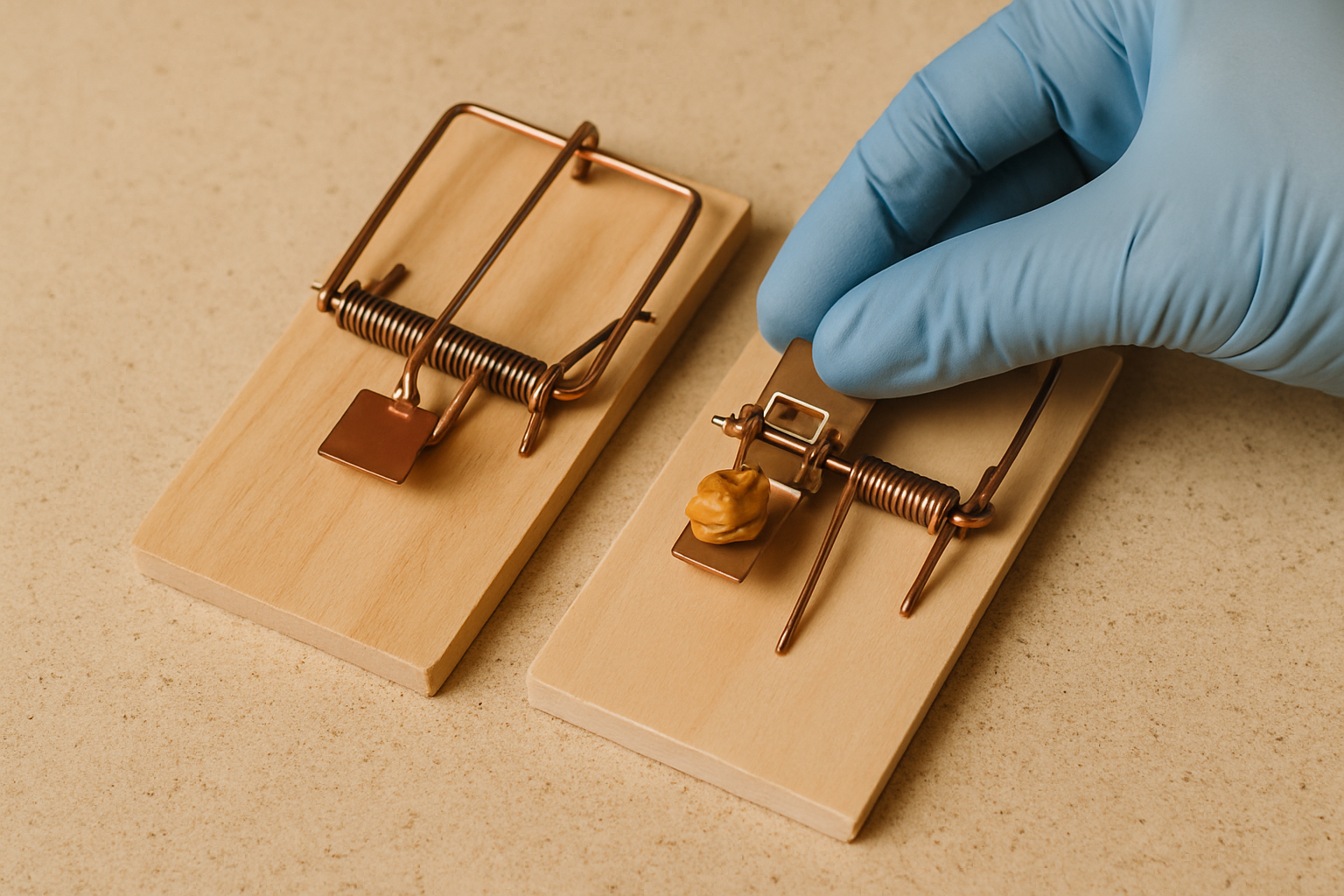
Common Trapping Mistakes and What to Do Instead
These are the four issues I run into most often when someone tells me their traps are catching nothing.
| What people do | Why it fails | What works better |
|---|---|---|
| One trap in the middle of the floor | Mice travel along walls, not open space | Traps flush against the baseboard, trigger toward the wall |
| Two or three traps for the whole house | Coverage gaps let mice route around them | Pairs of traps every 6 to 10 feet along active walls |
| A large glob of bait | Mouse feeds off the edge without tripping it | A pea-sized smear pressed into the trigger |
| Moving traps daily, bare hands | Human scent and constant change create trap shyness | Gloves on, set them, leave them alone for a week |
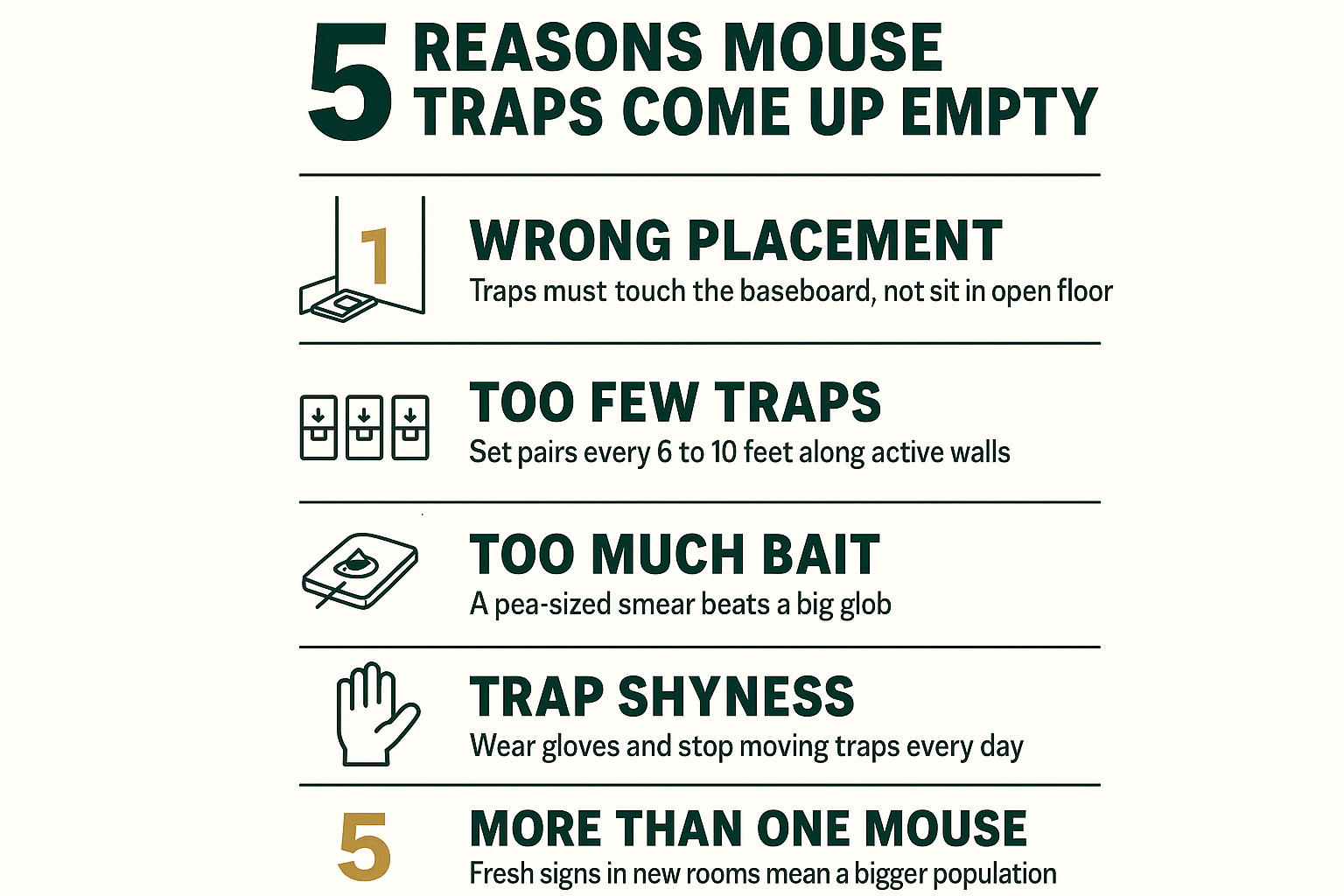
A Quick Checklist Before You Buy More Traps
Run through these five checks before assuming the mice are gone or the traps are defective.
In the Wooded Parts of the County, It May Not Be a House Mouse
This is the part that changes the whole approach, and most homeowners have never heard it.
If you live in Ben Lomond, Corralitos, the Aptos hills, or anywhere backed up against oak and redwood, the mouse in your kitchen may be a deer mouse rather than a house mouse. Bigger eyes, white belly, distinctly bicolored tail.
Deer mice behave differently around traps and bait. They are more tied to the outdoors, they come and go from the structure more, and they respond less predictably to the standard kitchen setup.
There is also a legal piece. UC guidance notes that rodent baits labeled only for house mice, Norway rats, and roof rats cannot be used against deer mice, so trapping and cleaning up what draws them in carry the load on those properties.
I got a call not long ago from new tenants moving into a cabin in the woods near Aptos who found mice before the boxes were unpacked. That is a normal thing to walk into out there, not a sign the place is a disaster.
One practical note: wear gloves and avoid sweeping or vacuuming dry droppings and nesting material. Dampen the area first and bag it. That applies anywhere, but it matters more in rural properties where deer mice are in the mix. If you are not sure what you have, our post on how to tell mice from rats covers the size and sign differences.
What Empty Traps Plus Fresh Signs Actually Tells You
Here is the useful read. If the traps stay empty but the evidence keeps piling up, you are probably not dealing with one straggler.
Watch for these together:
- Fresh droppings showing up in different rooms, not just the one kitchen corner
- Gnawed food packaging, especially in a pantry or garage shelf
- Greasy rub marks along baseboards where the same route gets used nightly
- Scratching that moves through walls or across a ceiling
Activity in multiple rooms plus sounds in the wall structure points to more than one animal and a way in from outside, not a single mouse that wandered through an open door.
Timing matters here too. Santa Cruz County nights cool off early once the fog pattern shifts in late summer, and rodents push indoors sooner here than they do inland.
So activity in August and September often escalates rather than fades, which surprises people who expect a winter problem. If the noise is overhead rather than at floor level, what those attic sounds mean is a better starting point than more kitchen traps.
The Poison Question, Answered Straight
This is the fork in the road most people hit after a week of empty traps. Should you just put bait out?
Most of my customers in this county say no before I even bring it up, and their reasons are good ones. Dogs, kids, and the owls, hawks, and neighborhood cats that hunt in Santa Cruz yards all factor in.
There is also a plain practical problem. A rodent that dies inside a wall creates an odor that can last several weeks, and there is no quick fix for it once it happens.
California’s rodenticide rules have also tightened considerably in recent years, which narrows what is available and where it can be placed. Our breakdown of what changed in California’s rat poison rules covers that in more detail.
Trap based work paired with cutting off food and water sources looks slower on day one. In my experience it holds up better, because you know exactly what you removed and you are not counting on something you cannot see. The same thinking is behind IPM in homes with kids and pets.
No method ends a rodent issue permanently, and anyone telling you otherwise is selling something. What you are after is control of the active problem and fewer reasons for the next one to move in.
When It Makes Sense to Have Someone Look
If you have moved traps against the wall, doubled them up, cut the bait down, and left them alone for a week, and you are still seeing fresh signs, more traps is not the answer.
What a technician adds at that point is judgment, not equipment:
- Species identification, which determines what is even legal and effective to use
- Reading the travel routes and figuring out where animals are coming and going
- Adjusting trap type and placement over follow up visits instead of guessing once and hoping
One customer wrote after an inspection that found two spots in his exterior walls where mice were getting in: “Mathew was very knowledgeable about critters and insects and shared a few pointers with me about best baits for mice/rats.” He also left a modern metal rat trap behind.
That kind of plain explanation is what callers here tell me they never got from the bigger chains. Cost varies with the size of the home, whether crawlspace and attic access is involved, and how many follow up visits the situation needs, so an on-site look is the only honest way to price it.
Frequently Asked Questions About Mouse Traps Not Catching Mice
How long should I leave a mouse trap before deciding it is not working?
Give it a full week without touching it. Mice are cautious about new objects in a familiar space, and constantly checking or repositioning traps resets that clock every day.
Does it matter what bait I use?
Less than you would think. Location beats bait every time. Peanut butter works fine, but use a pea-sized smear pressed into the trigger rather than a glob a mouse can lick off the side.
My traps are empty but I still hear noise in the walls. What does that mean?
Usually that the animals are not routing through the room where your traps are, or that there is more than one. Noise moving through walls or across a ceiling suggests a route in from outside rather than a single mouse in the kitchen.
Can I catch mice live and release them somewhere else?
Relocating live rodents is restricted in California, so it is not a workable plan. It also tends to fail on its own terms, since a released mouse rarely survives in unfamiliar territory.
Do I need to worry more if I live up in the mountains?
Not worry, just plan differently. Homes near woods in Ben Lomond, Corralitos, or the Aptos hills often have deer mice rather than house mice, and that changes what treatment options are legal and what trapping approach works. Handle droppings and nests with gloves either way.
Still Getting Empty Traps and Fresh Droppings?
If you have worked through the placement and bait fixes and the activity is still there, a look at the travel routes usually explains why. West Pest Co. is owner operated here in Santa Cruz County, Matthew often takes the call himself, and same day visits are usually possible. You can reach us at (831) 430-8402 or at westpestco.com.