When you need to get rid of ants fast, your best bet is a simple, non-toxic spray: a 50/50 mix of white vinegar and water. This is your first line of defense. The spray instantly erases the invisible pheromone trails ants use to navigate, which immediately throws their single-file line into chaos and stops more from joining the party. It's the most critical first step to take back your kitchen.
Identifying and Disrupting Your First Ant Trail
Spotting that first, determined line of ants marching across your counter is a call to action. But before you reach for harsh chemicals, take a breath. A quick, strategic response with natural ingredients is far more effective for long-term control. Your immediate goal is twofold: stop their current invasion and gather clues to prevent the next one. This initial response sets the stage for a truly ant-free home.
This simple process breaks down the immediate actions to take the moment you spot an ant trail.
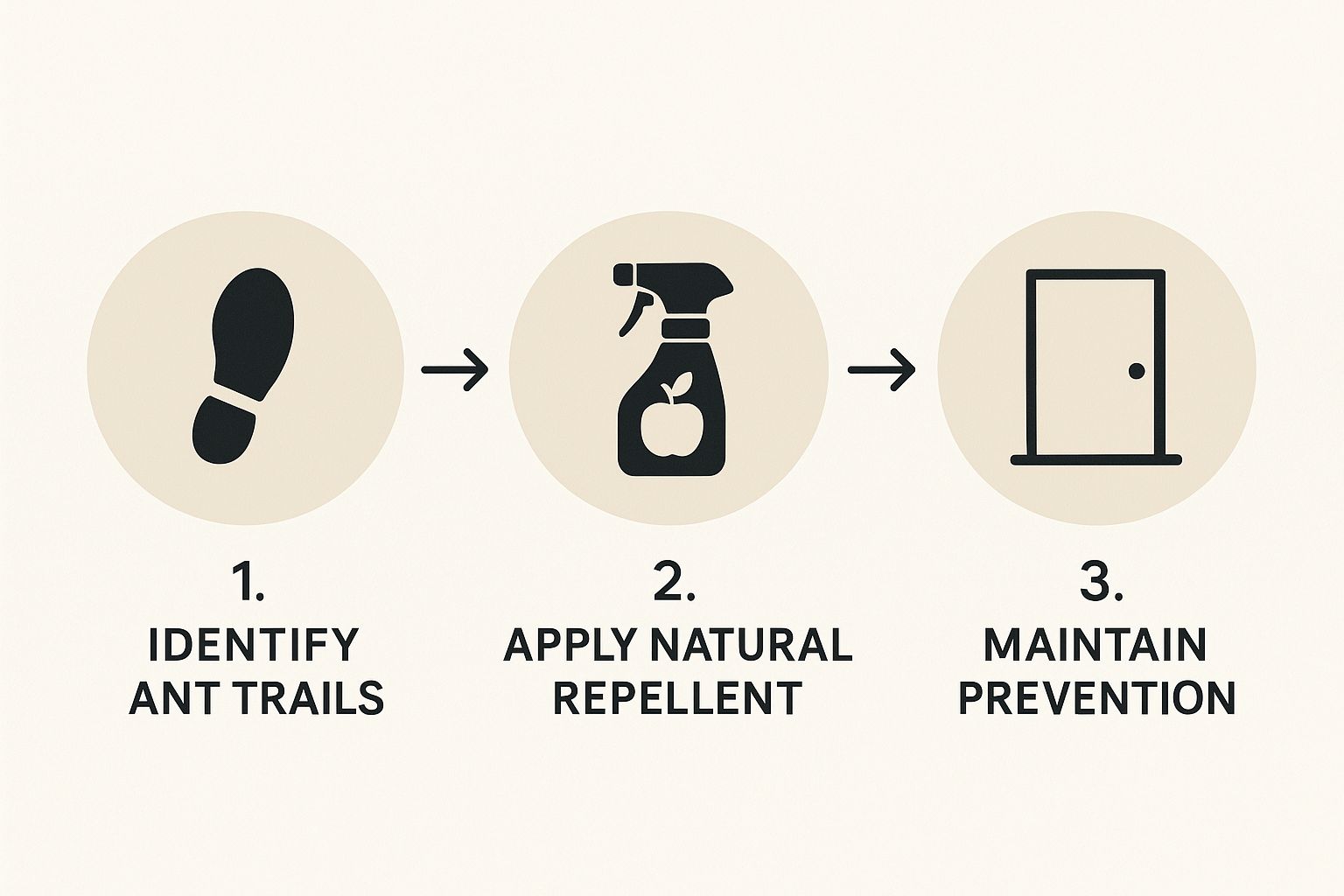
As you can see, the strategy is a logical flow, moving from immediate disruption to smart, long-term prevention.
Observe the Invaders
Before you wipe them all away, take a second to play detective. What are they after? A smear of jam? A dropped potato chip? This is a crucial clue.
Most common household ants are either sugar ants, drawn to anything sweet, or grease ants, which are on the hunt for proteins and fats. Figuring out their preference is key to choosing the right natural bait later on. You don't need a formal ID—just knowing what they're eating is enough for now.
We can use this information to choose a more effective bait. Below is a quick guide to help you match the ant to the right natural solution.
Quick Guide to Natural Ant Baits
Match the ant you see to the right natural bait for the most effective results.
| Ant Preference | Effective Natural Bait | How It Works |
|---|---|---|
| Sugar Ants (attracted to sweets) | Borax and powdered sugar mix | Ants carry the sweet bait back to the colony, where the borax acts as a slow-acting stomach poison, eliminating the nest from the inside. |
| Grease/Protein Ants (attracted to fats) | Borax and peanut butter mix | Similar to the sugar bait, the ants are drawn to the protein and carry the borax-laced food back to their nest, targeting the source of the problem. |
Using the correct bait ensures the ants will actually take it, which is the whole point. This targeted approach is much more effective than just spraying the ones you see.
Erase Their Invisible Highway
Ants navigate using chemical signals called pheromones, leaving an invisible trail for their colony-mates to follow. Your first strike is to completely obliterate this chemical highway.
- Create Your Spray: Just mix equal parts white vinegar and water in a spray bottle. The acetic acid in vinegar is a powerful, natural cleaner that neutralizes pheromones on contact.
- Spray and Wipe: Generously spray the entire ant trail, from where they're coming in to their destination. Let it sit for a minute, then wipe the area clean. This not only deals with the current ants but also erases the path for any future scouts.
Pro Tip: For a nicer-smelling alternative that works just as well, add 15-20 drops of peppermint essential oil to your vinegar spray. Ants can't stand the strong scent, which further messes with their ability to communicate.
Trace and Seal the Entry Point
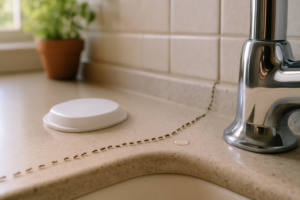
Now, follow the ant trail backward to find out how they got in. Check for minuscule cracks in the caulk around windows, tiny gaps along baseboards, or crevices near the pipes under your sink. These are the secret doorways for your unwanted guests.
Once you find the entry point, seal it up immediately. A small dab of caulk, putty, or even a temporary fix like petroleum jelly can block the entrance. This physical barrier is a non-negotiable step to stop the flow of new ants while you get the bigger problem under control. This initial containment is absolutely key to getting rid of ants naturally and keeping them out for good.
Using Kitchen Staples to Eliminate Ant Colonies
Alright, you've disrupted the ant trail. Now it's time to switch from defense to offense. The real goal isn't just scattering the ants you can see—it's about targeting the entire colony right at its source. The good news is your kitchen pantry probably has everything you need for this mission, offering some surprisingly effective, pet-safe, and child-friendly solutions.
These DIY baits are clever because they get the ants to do the dirty work for you. Foraging ants will find the bait, think it's food, and haul it back to the nest to share with the queen and the rest of the colony.
The Sweet and Deadly Baking Soda Bait
One of the most popular natural ant killers is a simple mix of baking soda and powdered sugar. The idea behind it is genius. The powdered sugar is the irresistible lure for any sweet-loving ant species, while the baking soda is the hidden, lethal ingredient.
To mix up this bait:
- Combine equal parts powdered sugar and baking soda and mix them together thoroughly. It’s absolutely critical to use powdered sugar, not the granular kind, because clever ants can sometimes separate the larger sugar crystals from the baking soda, defeating the purpose.
- Spoon the mixture into shallow containers. Bottle caps or small squares of cardboard work perfectly.
- Place these bait stations directly on the ant trails you found earlier.
Worker ants will happily gobble up the sugary mix and carry it back to share. Once ingested, the baking soda reacts with the natural acid in an ant's digestive system, creating a chemical reaction that proves fatal.
A Stronger Approach with Borax
If you're dealing with a more stubborn infestation and need something with more punch, you can turn to borax. It's a naturally occurring mineral that acts as a powerful, slow-acting poison for ants. That delay is the secret to its success—it gives the worker ants plenty of time to get the poison back to the nest before they die.
Many home remedies involve mixing borax with a sweet substance to attract ants. Their success, however, depends entirely on workers carrying the bait back to the colony for the queen to eat. These solutions are often slower and less of a sure thing than professional treatments, so they're best for smaller infestations.
To use borax safely and effectively, you’ll want to create a bait by mixing it with something sweet and sticky.
- Jelly or Syrup Bait: Combine one part borax with three parts jelly, honey, or syrup.
- Peanut Butter Bait: If you're dealing with grease ants, mix one part borax with three parts peanut butter.
Place these baits in areas with known ant activity but make absolutely sure they are out of reach of pets and children. Borax is toxic to mammals if ingested, so careful placement is non-negotiable.
Safety First: A great trick for using borax baits is to put them inside a sealed plastic food container. Just poke a few small holes in the lid or sides—small enough for ants to get in, but too small for curious paws or little hands to touch the mixture.
These kitchen-based strategies are a fantastic way to get rid of ants naturally, especially when you're facing minor to moderate issues. Getting rid of pests in your kitchen is all about a consistent approach. For more specific tips, take a look at our complete guide on how to kill kitchen ants.
Creating a Natural Fortress Against Future Invaders
Once you've handled the ants you can see, the real work begins: making sure they can't get back inside. The most sustainable way to get rid of ants for good is to make your home a place they simply can't enter. This doesn’t mean you have to reach for harsh chemicals. It’s all about creating a smart, powerful perimeter defense using substances ants can't stand.
Think of it as creating a "no-go zone" around your home's most vulnerable spots. You’ll want to focus on doorways, windowsills, and any cracks in the foundation where pipes or wires come through. To a scouting ant, these are flashing neon signs pointing the way in.
Deploying a Microscopic Barrier
One of the most effective natural defenders you can use is food-grade diatomaceous earth (DE). This isn't a poison; it's a desiccant. DE is a fine powder made from the fossilized remains of tiny aquatic organisms. To us, it feels like flour, but to an ant, it’s like walking across a field of microscopic glass shards.
These sharp particles scratch the waxy coating on an ant’s exoskeleton, causing it to lose moisture and dehydrate. Because it works physically, not chemically, DE is a purely defensive barrier—it won't be carried back to wipe out the colony, but it will stop scouts in their tracks. Using a powder duster, puff a very thin, almost invisible line of DE along:
- Foundation Perimeters: Create a continuous line around the entire base of your house.
- Door and Window Thresholds: Apply a light dusting right where they would crawl inside.
- Around Pet Food Bowls: A simple circle of DE can keep foragers away from your pet's dinner.
A key thing to remember is that you'll need to reapply diatomaceous earth after a heavy rain or watering, as moisture makes it ineffective. The barrier has to stay dry to do its job.
Scrambling Communication with Scent
Ants navigate the world using pheromone trails, which are basically chemical roadmaps. You can throw their entire system into chaos by using strong, natural scents that they find completely overwhelming. This simple tactic confuses them, disrupts their trails, and makes your home a much less appealing target.
A huge part of long-term success is learning how to keep ants away by making their environment unappealing from the start. This proactive mindset is your best defense.
Practical and Potent Scent Deterrents
You probably already have powerful ant repellents sitting in your spice cabinet. Unlike baits, the goal here isn't to kill them, but to make an area smell so unpleasant that they actively avoid it.
Here are a few of my go-to options and how to use them effectively:
- Cinnamon and Cloves: Both ground cinnamon and whole cloves have strong aromatic oils that ants absolutely despise. I've had great success sprinkling a line of ground cinnamon across known ant entry points. You can also place whole cloves on windowsills or in corners where you've seen activity.
- Citrus Peels: Don’t toss those orange, lemon, or grapefruit peels! The potent citrus oil is a fantastic natural repellent. Just scatter the peels in problem areas, like near garbage cans, under sinks, or along baseboards.
- Chalk Lines: It might sound like an old wives' tale, but drawing a thick line with simple sidewalk chalk can be a surprisingly good barrier. The calcium carbonate in the chalk physically disrupts an ant's ability to follow a pheromone trail. This is an easy and cheap fix for patios, porches, and doorways.
Advanced Natural Solutions for Tough Infestations
Sometimes, despite your best efforts with kitchen remedies, a stubborn ant army just won't surrender. We’ve all been there—you’ve sprayed the vinegar, laid down the diatomaceous earth, and the ants just keep marching.
When you're facing a more serious invasion, it's time to call in stronger, yet still natural, reinforcements. These solutions bridge the gap between simple DIY methods and harsh synthetic chemicals, offering potent results without compromising your eco-conscious principles. You don't have to give up on your commitment to natural methods; you just need to escalate your approach.
What Are Nature-Derived Insecticides?
When standard methods fall short, you can turn to advanced, nature-derived insecticides that pack a serious punch. These aren't synthetic chemicals cooked up in a lab. Instead, they are formulated with powerful active ingredients that come from natural sources, making them a responsible choice for tough situations.
One of the most effective ingredients to look for is spinosad. This is a powerful compound derived from the fermentation of a common soil bacterium—it’s literally a product of nature, harnessed for its potent insect-killing properties.
Spinosad works by targeting an ant’s nervous system, leading to paralysis and quick elimination. Unlike gentler repellents, this ingredient is designed for eradication. It’s the ideal next step when you need fast, decisive action against a large or persistent ant colony that has shrugged off your earlier efforts.
These advanced natural products are proof that you don't have to choose between effectiveness and environmental safety. They deliver results that rival their synthetic counterparts while being much friendlier to the surrounding ecosystem and safer for your family and pets when used as directed.
Finding and Using These Powerful Solutions
When you're shopping for these next-level natural ant killers, it’s crucial to read the label. Look for "spinosad" listed as the active ingredient on products designed for outdoor or perimeter use. You'll find it in various forms, including ready-to-use sprays and concentrates that you mix with water.
The effectiveness of these biological insecticides is backed by real-world science. For instance, recent studies have shown just how fast-acting they can be. Treatments using spinosad achieved over 90% ant mortality just 8 hours after application, reaching 100% mortality within 10 hours.
This rapid action shows that natural options can be just as potent as synthetic alternatives. You can explore the full findings of this impactful research to see how these natural insecticides performed for yourself.
To get the most out of these products, here’s what I recommend:
- Target Entry Points: Don't just spray randomly. Apply the solution strategically along your home’s foundation, around door and window frames, and anywhere you've seen ants getting in. Create a barrier.
- Treat Nests Directly: If you can locate the ant mound—and sometimes this takes a bit of detective work—a direct application is the most efficient way to wipe out the entire colony at its source.
- Follow Directions Carefully: This is non-negotiable. Always adhere to the product label for mixing ratios and application instructions to ensure both safety and maximum effectiveness.
By turning to these advanced solutions, you can finally conquer even the most relentless ant infestations without straying from your values.
Building Long-Term Habits for an Ant-Free Home
Once you’ve won the initial battle against an ant invasion, the real work begins. The war is won by adopting smart, sustainable habits that make your home and yard permanently unwelcoming to these tiny foragers. This is how you shift from reactive defense to proactive prevention, ensuring you can get rid of ants naturally and keep them gone for good.
It all boils down to consistency. A single crumb left on the counter or a sticky spot of juice on the floor is like rolling out the red carpet for a new scout to establish a trail. By weaving a few simple routines into your daily life, you create an environment where ants have absolutely no reason to visit.
Non-Negotiable Kitchen Routines
The kitchen is ground zero for most ant infestations, so this is where your new habits need to be the most rigorous. Your goal is to keep the kitchen in a constant state of "uninteresting" for any passing ant.
This means wiping down countertops after every meal, sweeping floors daily to catch stray crumbs, and mopping up spills the moment they happen. Don't forget the easily overlooked spots, like the toaster crumb tray or the area underneath the microwave.
Key Takeaway: The objective isn't just a visibly clean kitchen; it's a food-source-free kitchen. An ant's incredible sense of smell can pick up on tiny residues you might not even see, so being thorough is everything.
You also need to get ruthless with your food storage. Flimsy cardboard boxes and thin plastic bags are no match for a determined ant colony.
- Seal Everything: Transfer pantry staples like cereal, sugar, flour, and snacks into airtight glass or hard plastic containers.
- Remember Pet Food: Don't leave pet food bags open on the floor. Store kibble in a sealed container and wash food and water bowls daily to get rid of any tasty residue.
- Manage Your Trash: To truly achieve an ant-free home long-term, building consistent habits around cleanliness and food storage is key. This includes regularly disposing of food scraps using effective waste management solutions like compostable trash bags, which help eliminate ant attractants.
Extending Your Defense Outdoors
Your yard can act as a staging ground for a full-blown home invasion. A little landscape maintenance can make a massive difference in preventing ants from ever reaching your foundation in the first place. The key is to remove the "bridges" and food sources they depend on.
One of the most common ways ants get inside is by traveling along overhanging tree branches or shrubs that touch your house. Trim back any vegetation so there is at least a six-inch gap between the plant and your home's siding or roof. This simple step removes a major ant highway.
Plus, many ants "farm" aphids for the sweet honeydew they secrete. If you have plants in your garden covered in these tiny pests, you're essentially running an all-you-can-eat buffet for ants. Managing aphids with natural solutions, like a strong spray of water from the hose or applying neem oil, cuts off this critical food supply.
By combining these indoor and outdoor habits, you create a comprehensive, layered defense. If you're looking for more ideas on creating an eco-friendly barrier, explore our guide to natural pest control.
Of course. Here is the rewritten section, crafted to sound like it was written by an experienced human expert, following all the provided guidelines and examples.
Common Questions About Going All-Natural on Ants
Even with the best intentions, switching from conventional sprays to natural ant control can feel a bit like learning a new language. You're bound to have questions, especially when you're used to the instant results of chemical treatments. Let's walk through some of the most common things people ask when they decide to tackle ants the natural way, so you can move forward with confidence.
One of the biggest mysteries? Why a line of ants suddenly materializes in a kitchen you just cleaned. You wiped every counter and swept the floor, but there they are. The frustrating truth is, it takes almost nothing to roll out the welcome mat for them. A single crumb you missed under the toaster, a sticky drop of honey on the outside of the jar, or even just a damp sponge in the sink can be the homing beacon for a scout ant, who then alerts the entire colony.
How Long Does This Stuff Actually Take to Work?
This is where a little patience really pays off. Unlike chemical sprays that kill on contact, natural solutions are playing the long game.
- Repellents (like vinegar or essential oils): These are your immediate defense. They work right away to throw ants off their scent trails and make an area unattractive. But they don't solve the root problem—the nest. You'll need to reapply them regularly, especially after you wipe down counters or if it rains outside.
- Baits (like borax or baking soda mixtures): These are your colony-killers. The goal here is a slow, methodical takedown, which can take anywhere from a few days to over a week to show a major drop in ant traffic. This delay is actually what you want to see. It means the worker ants have plenty of time to carry the bait back to the nest and share it with the queen and the rest of the colony.
The whole point of a natural bait is to get to the source: the queen and her nest. If you see ants swarming the bait at first, don't panic. That’s not failure—it’s the first sign that your plan is working.
Are These Solutions Safe to Use in My Garden?
Great question. The answer really boils down to which method you're using. Many natural repellents are completely harmless for your garden and can even do some good.
For example, you can scatter used coffee grounds or citrus peels around the base of your plants without any worry. They deter ants and enrich the soil. But you have to be more strategic with other solutions. A soapy water spray can scorch the leaves of delicate plants, and pouring boiling water on a nest will absolutely kill the grass and any plant roots in that spot. Always apply these with precision, aiming only for the nest opening itself.
Food-grade diatomaceous earth is generally safe for the soil, but it’s an equal-opportunity killer that can harm beneficial insects like bees and ladybugs if you dust it all over your blooming flowers. A much better strategy is to use it as a dry barrier around the perimeter of your garden beds. This approach helps you get rid of ants without disrupting your garden's delicate ecosystem.
If you're facing a persistent pest problem and need a reliable, eco-friendly solution, the experts at West Pest Co. are here to help. We offer customized pest control that respects your home and the environment. Contact us today for a thorough inspection and a long-term solution.