Direct Answer: The most common black and brown spiders found in Santa Cruz homes are the western black widow, the false black widow, and the cellar spider. Knowing which one you’re looking at helps you decide whether to act fast or just keep an eye on things.
A lot of people reach out to us after finding a large, dark spider somewhere in their home, a garage corner, a closet, behind the water heater. The first question is almost always the same: is this one I should worry about? That’s a fair question, and the honest answer depends entirely on which spider you’re looking at.
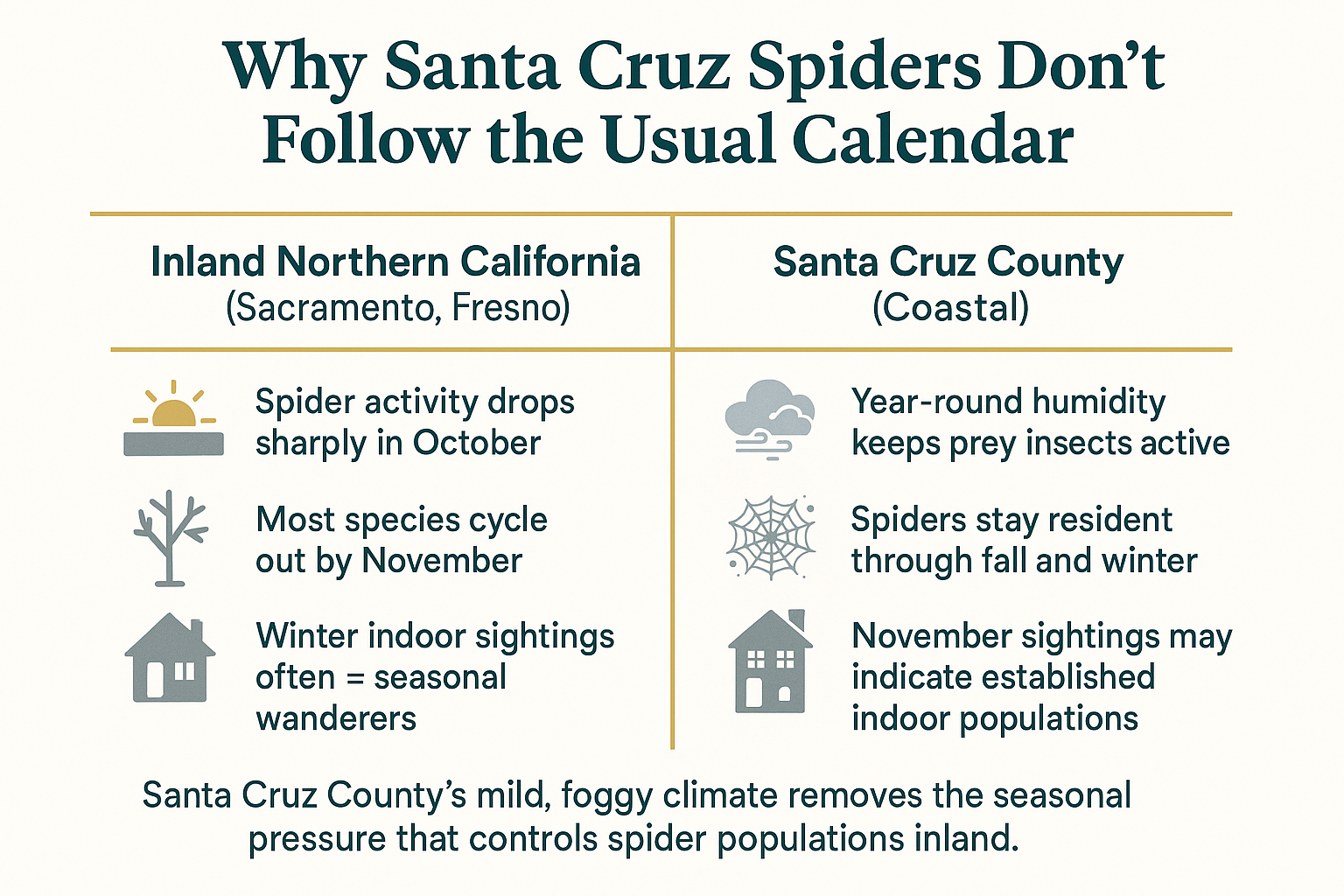
Santa Cruz is an interesting place to think about spider identification because the climate changes the equation. Our cool, foggy coastal weather means spider populations stay active here well into fall and winter, when inland parts of Northern California see a significant die-off. A homeowner in Sacramento who finds a big spider in October is probably looking at a seasonal wanderer on its way out. A homeowner on the west side of Santa Cruz in November may be seeing a resident population that never really left.
This article covers the three black and brown spider species that show up most often in Santa Cruz County homes, where you’re likely to find each one, and how to tell them apart without needing a magnifying glass. I’ll also help you figure out when a sighting is worth a call versus when a sticky trap is probably all you need.
The Western Black Widow: What It Actually Looks Like Up Close
The western black widow is the one species in Santa Cruz County that genuinely warrants immediate attention, especially in homes with children or pets. Misidentification is common, so it helps to know exactly what you’re looking for.
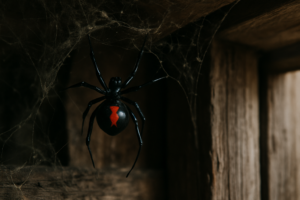
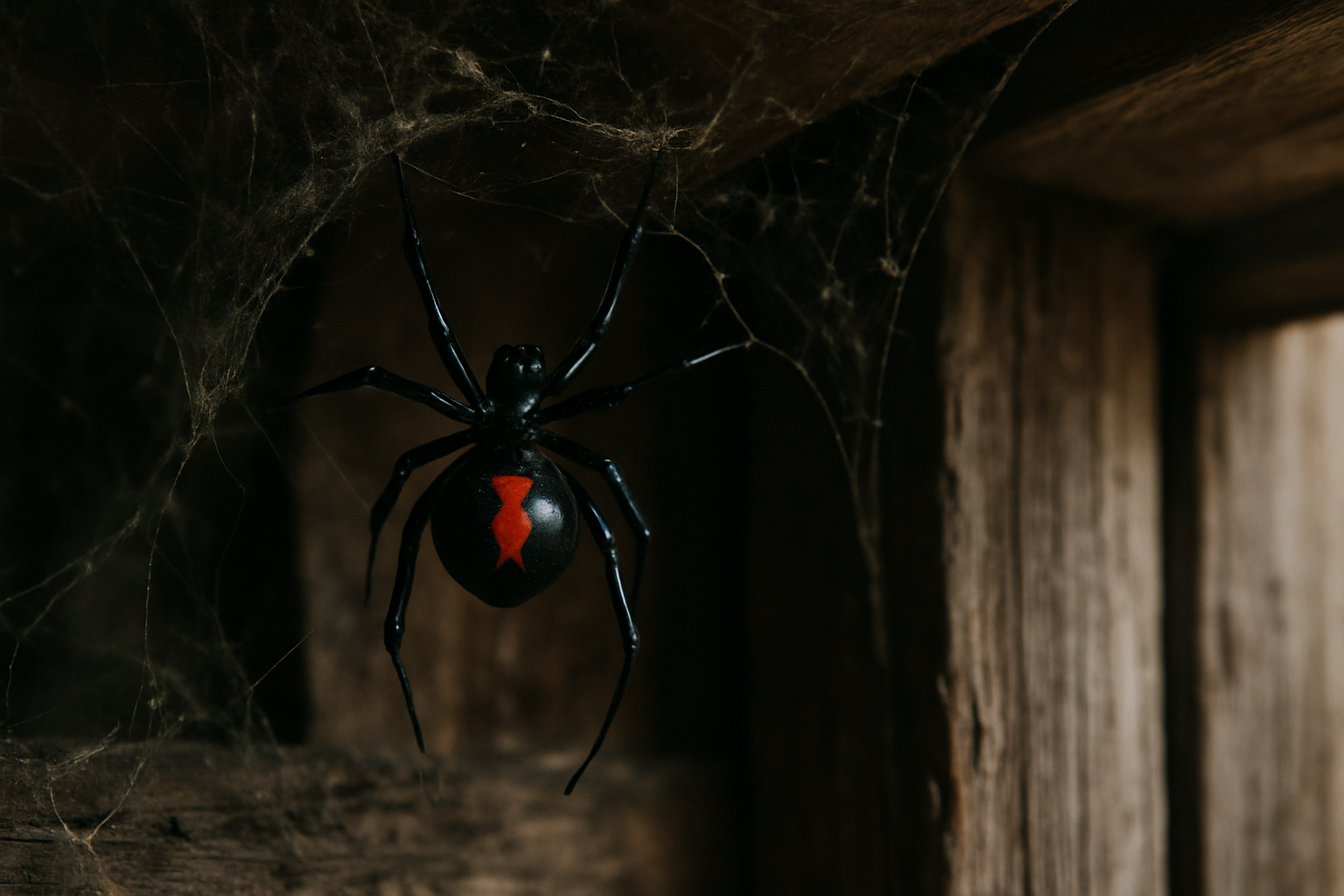
The body of a mature female is shiny, jet black, and roughly the size of a large grape seed, about half an inch long. The key marking is the red hourglass shape on the underside of the abdomen. You will not see this unless you are looking at the spider from below, which is not something most people do intentionally. The web itself is a useful clue: black widow webs are irregular and sticky-feeling, often with a funnel shape near the retreat point. They are not the neat, circular orb webs most people picture.
In Santa Cruz homes, black widows turn up most often in:
– Garages, especially along the floor near clutter, firewood, or stored gear
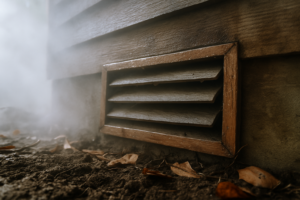
– Crawl spaces and the underside of raised foundations
– Under eaves and deck boards, particularly on the shaded north-facing sides of a house
– Meter boxes and utility enclosures mounted to exterior walls
Immature black widows and males look different, they can be brown or mottled with orange and white markings, which is part of why they get confused with other species. If you see a shiny black spider with a round abdomen and a red hourglass anywhere near a play area or a space children access regularly, treat it as a black widow until you know otherwise. You can read more about how we approach spider identification and treatment in our guide to spiders common to Santa Cruz.
The False Black Widow: Common, Misidentified, and Not Harmless
The false black widow (Steatoda grossa) is probably the spider we hear about most from homeowners who are convinced they have a serious problem. It looks enough like the real thing to cause genuine alarm, but there are clear differences once you know what to check.
The false black widow is dark brown to purple-brown, with a round, bulbous abdomen similar in shape to the western black widow. The critical difference: there is no red hourglass. You might see faint pale markings on the top of the abdomen, but the underside lacks the distinctive hourglass entirely.
These spiders gravitate toward wall voids, which makes older Santa Cruz homes, particularly craftsman bungalows and mid-century construction on the west side and in Seabright, common spots to find them. They prefer dark, undisturbed areas and build messy, cobweb-style webs in corners, behind furniture, and along baseboards.
False black widows can bite, and their venom can cause localized pain, redness, and swelling, though serious reactions are uncommon in healthy adults. They are still not a spider to dismiss, particularly around young children. The fact that they prefer wall voids also means a few visible spiders in an older home sometimes signals a larger hidden population than what you can see.
One caller we spoke with recently described finding spiders throughout an ADU with an unhappy tenant, multiple sightings in corners, along baseboards, and near windows. That pattern of distribution across multiple rooms in an older structure is a different situation than one spider in a corner of the garage.
The Cellar Spider: Harmless but Easy to Mistake
Cellar spiders (Pholcus phalangioides and related species) are the long-legged, pale spiders most people call daddy long-legs. They are genuinely harmless to humans, but they show up in large numbers in Santa Cruz homes and can look alarming when you walk into a closet full of them.
A few quick identifiers:
– Very long, thin legs relative to a small body, the leg span can exceed two inches on a spider whose body is barely a quarter inch
– Pale tan to gray-white coloring, sometimes almost translucent
– Chaotic, loosely spun webs in high corners, closets, basement spaces, and behind rarely-moved furniture
– When disturbed, they vibrate rapidly in their web, a distinctive defensive behavior
Cellar spiders are often the explanation when someone describes a corner full of webbing but can’t find a spider with any obvious markings. They are not venomous in any practical sense, and they actually prey on other insects, including other spiders. If the only spider you are finding is the long-legged pale one in bathroom corners and closets, that is a much lower-urgency situation than a dark, round-bodied spider near a foundation.
That said, heavy cellar spider activity can indicate a broader insect presence in the home, since they need prey to survive. If you are seeing a lot of them alongside other insect activity, that is worth paying attention to. What IPM pest control means for homes with kids and pets explains the kind of whole-picture thinking that applies well here.
Black and Brown Spiders in Santa Cruz: Quick ID Reference
Use this table as a starting point when you are trying to figure out what you found. For any venomous species or an uncertain sighting near children, a professional look is worth the call.
| Species | Color | Key Marking | Typical Indoor Location | Concern Level |
|---|---|---|---|---|
| Western Black Widow | Shiny black | Red hourglass on underside | Garage floor, crawl spaces, eaves, utility boxes | High, especially near kids or pets |
| False Black Widow | Dark brown to purple-brown | No hourglass; faint pale marks on top | Wall voids, corners, older home baseboards | Moderate, can bite, often more numerous than visible |
| Cellar Spider (Daddy Long-Legs) | Pale tan to gray-white | No distinctive markings; very long thin legs | High corners, closets, basements, bathrooms | Low, harmless; signals insect prey nearby |
How Santa Cruz’s Climate Keeps Spiders Active Longer
This infographic compares spider activity timing on the Central Coast versus inland Northern California, a key reason why identification matters here year-round, not just in summer.
When One Spider in a Corner Is Fine, and When It Isn’t
This is the part most identification articles skip, and it is honestly the most useful thing I can tell you. Not every spider sighting is a problem that needs a professional. But some situations clearly are, and knowing the difference saves you time, money, and stress.
A single sticky trap and some exclusion caulk is probably enough when:
– You find one or two cellar spiders in a bathroom or closet corner
– You spot a single brown spider with no visible markings near a window, and it is gone the next day
– Webbing is appearing in one corner of a garage or shed that is rarely used
It is worth calling a professional when:
– You find a black, shiny, round-bodied spider, especially near a child’s play area, under patio furniture, or in a crawl space your kids or pets can access
– You are seeing multiple dark spiders in different parts of the house over a short period
– Webs are appearing throughout a room or across multiple spaces in an older home
– A tenant or family member has been bitten and the bite site is swelling or showing spreading redness
– You have already found one confirmed or suspected widow and you are not sure if there are more
The UC Davis Integrated Pest Management Program has solid guidance on black widow identification and when bites require medical attention, worth bookmarking if you have young children.
I find that the homeowners who call us after the most stressful situations are usually the ones who waited too long because they were not sure what they were seeing. One woman who recently moved into an older home on the west side described finding what she thought were ‘tons of spiders’ throughout the house, inside and outside. She specified needing something non-toxic inside because of her kids. That is exactly the kind of situation where getting a trained eye on it early is better than waiting to see if it sorts itself out.
For more context on how when to stop trying to handle a pest problem on your own applies to spiders specifically, that post walks through the signals that tell you a DIY approach has run its course.
A Note on Eco-Friendly Treatments for Indoor Spider Control
One of the most common things we hear from Santa Cruz homeowners is a version of: ‘I need this handled, but I have kids, I need whatever you use inside to be non-toxic.’ That concern is completely reasonable, and it is worth knowing that it does not have to be a trade-off.
For spiders specifically, professional treatment typically involves residual spray and targeted dust application in areas where spiders nest and travel, combined with web removal and recommendations to reduce what is attracting the prey insects that spiders feed on in the first place. Many of the products used in an eco-friendly approach are botanically derived or rated for use in sensitive indoor environments.
The key is that treatment approach depends on what species you have and where they are concentrated. A false black widow in a wall void requires a different plan than cellar spiders in a bathroom corner. That is why a proper inspection comes before any application, not the other way around.
If you are thinking about this from an IPM standpoint, what pest inspectors actually look for inside your home gives you a clearer picture of that process.
Frequently Asked Questions About Spiders in Santa Cruz Homes
How do I tell a false black widow from a real black widow without turning the spider over?
The body shape is similar, both have a round, bulbous abdomen. The biggest visible clue without flipping the spider is the color and sheen. Western black widows are a deep, almost reflective black. False black widows are brown to purple-brown and look more matte. If you genuinely cannot tell and the spider is near a space children use, treat it as a widow and get someone to look at it.
Can spiders in Santa Cruz really be a problem in winter?
Yes, and this is genuinely different from what most of inland California experiences. Santa Cruz’s fog and mild temperatures keep the insect prey base active much later in the year, so spiders that would normally cycle out by November in Sacramento can remain resident and active here through January and February. Finding a large spider indoors in mid-winter in Santa Cruz is not unusual, it does not automatically mean something is wrong, but it is not the seasonal outlier it would be elsewhere.
I found one black widow near my garage door. Do I need a full treatment?
One sighting near a garage entry is worth taking seriously, but it does not automatically mean a full infestation. Black widows are somewhat territorial and do not always indicate a large population nearby. That said, garages with clutter, firewood, and stored equipment provide good habitat, and where there is one, a careful look around for egg sacs and additional webs is warranted. A professional inspection can tell you quickly whether you are looking at an isolated spider or a more established presence.
Are daddy long-legs actually dangerous?
No. The idea that cellar spiders are highly venomous but unable to pierce human skin is a persistent myth with no scientific backing. Cellar spiders are harmless. Their venom has not been shown to be dangerous to humans, and their fangs are capable of piercing skin, they simply have no practical interest in biting people. If the long-legged pale spiders are the only ones you are finding, there is nothing urgent to worry about.
I have a rental unit with a spider problem and a frustrated tenant. What should I document before calling?
Note where the spiders are appearing (specific rooms, corners, wall areas), how many sightings there have been over what period, and whether any webs are visible. If you or your tenant can photograph the spider clearly, ideally from above and, if possible, the underside, that helps with identification before anyone comes out. ADU and rental unit situations sometimes involve older wall structures with more void space, which can support larger false black widow populations than the visible count suggests.
Not Sure What You’re Seeing? A Local Eye Makes a Difference.
If you are finding dark, round-bodied spiders in your Santa Cruz home, especially near areas kids or pets use, it is worth getting someone out to confirm what you are dealing with. West Pest Co. serves all of Santa Cruz County, from the west side and Seabright to Aptos, Capitola, Scotts Valley, and beyond. Matthew West is reachable directly at (831) 430-8402, or you can learn more at westpestco.com.