Direct Answer: Insulation usually needs replacing where rats built runways, nests, or soaked it with urine. Trapping and access repairs come first, or the new material gets contaminated again.
The traps are set, or maybe they are already done doing their job. Now you are standing in the hallway with a flashlight pointed up through the attic hatch, trying to figure out whether the whole thing is a loss or just one corner of it.
That is one of the most common questions I get after a rodent job wraps up in Santa Cruz County. Homeowners want to know what has to come out, what can stay, and who they are supposed to call about it.
So this article skips the identification stage. If you are still trying to work out what is up there, start with what the sounds and signs in an attic actually mean. If you already know, keep reading, because order of operations is the part that saves people real money.
What rat damage to attic insulation actually looks like
Rats do not damage insulation evenly. They carve it up in patterns, and those patterns tell you how long they were up there and how far they ranged.
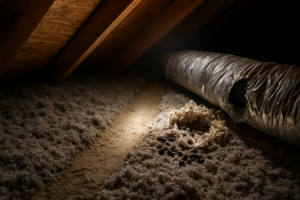
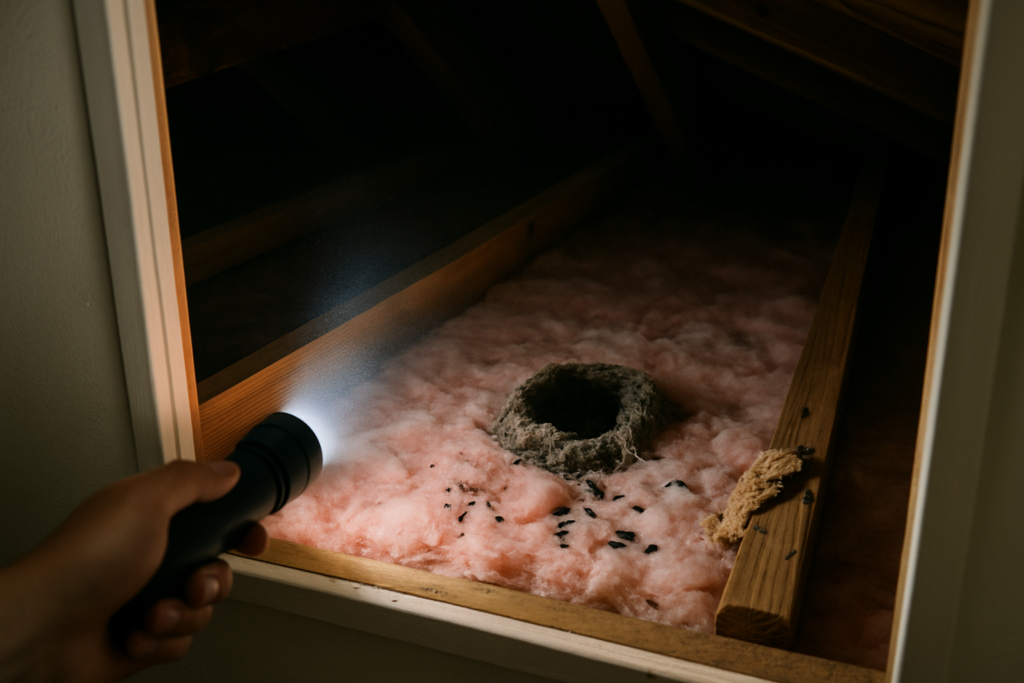
With blown in cellulose or fiberglass, look for:
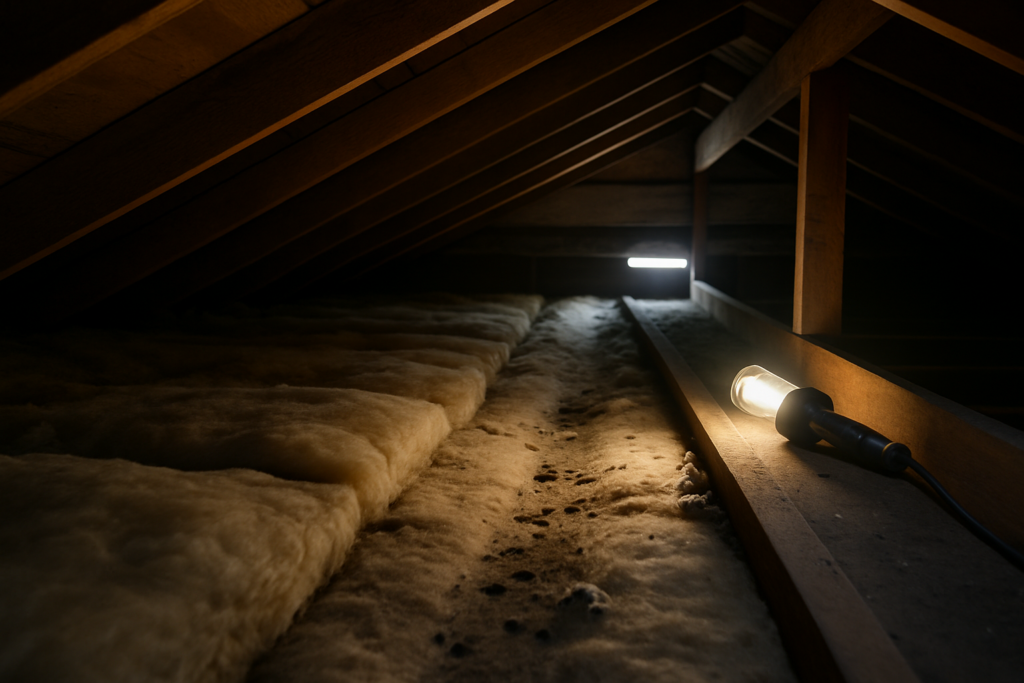
- Flattened runways where the fill has been packed down into narrow trails, often along the tops of joists or the edges of the attic deck
- Tunnels under the surface, which look like raised ridges until you press on them
- Hollowed nesting pockets, usually tucked against a wall plate or near a warm duct, lined with shredded paper, fabric, or insulation facing
- Droppings worked down into the fill instead of sitting on top, which is a sign of longer activity
With batt insulation, the damage reads differently. Batts get pulled apart, dragged, and stacked. You will see the paper or foil facing torn open, sections shoved aside to make room for a nest, and dark grease staining along the travel paths.
Then there is urine. It soaks into both types and stays there. Insulation that has been urinated on holds odor long after the animals are gone, and no amount of spraying changes that. That is the single most reliable reason to remove a section rather than try to salvage it.
If you are still not sure whether you are dealing with rats or mice, the difference matters for how much material gets contaminated.
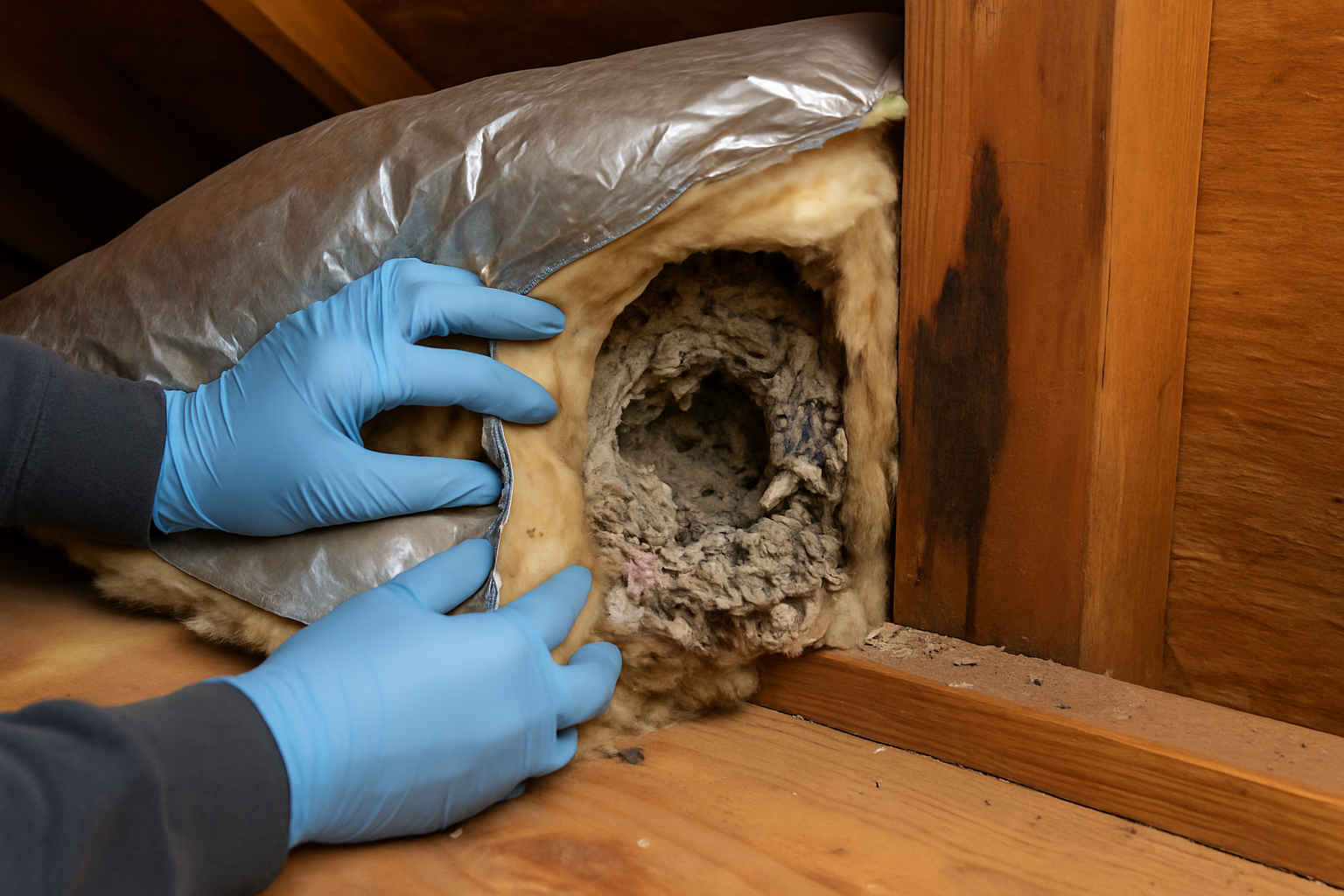
Ductwork is the part homeowners miss until the heat comes on
Nobody checks their ducts in July. Around here, heaters sit idle most of the year, so duct contamination often goes unnoticed until the first genuinely cold stretch in late fall.
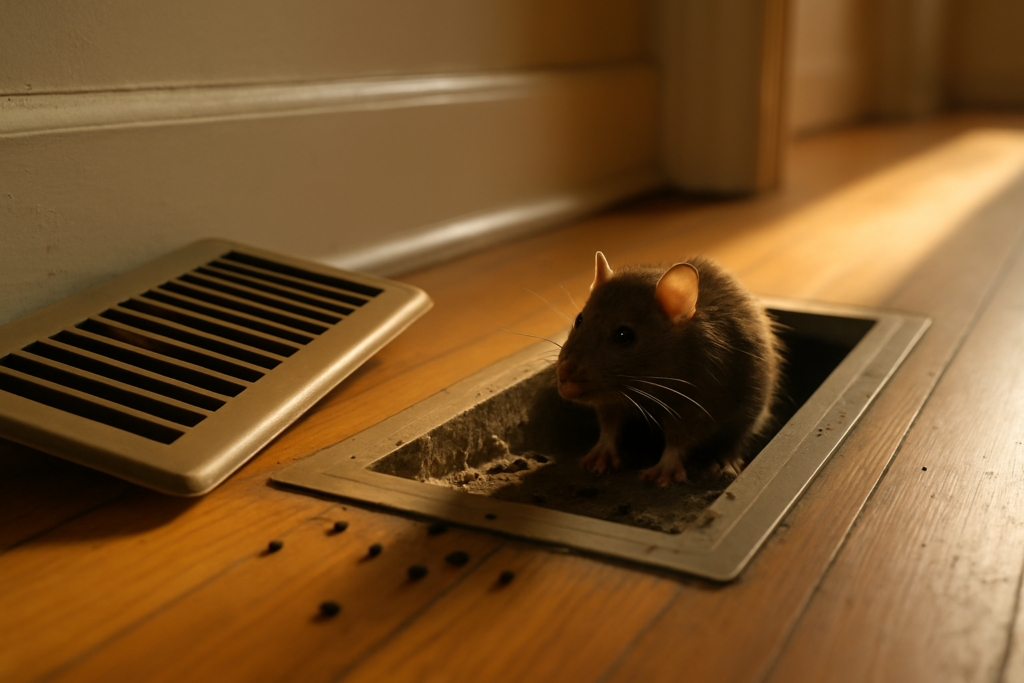
That is when I get the calls. One homeowner in the county told me she noticed sounds coming from the heating vents before anything else tipped her off. Another traced a moderate rat problem to an open cavity on the roof that led straight to mini split ducting, then asked exactly the right question: does the insulation and the ducting need to be replaced?
Here is what to look at, with a flashlight and no rush:
- Chewed or shredded flex duct wrap, especially where a duct passes close to a rafter or wall plate
- Torn vapor barrier or outer jacket, which lets attic air and debris into the airstream
- Droppings at floor and ceiling registers, which usually means material inside the run
- A musty smell the first week the heat runs, strongest right at the supply vents
- Crushed or collapsed sections where an animal traveled across a soft duct repeatedly
A chewed outer wrap is sometimes a patch. Material inside the duct, or a run that has been opened up and nested in, is usually a replacement conversation with an HVAC contractor.
The coastal angle matters too. Fog and humidity mean contaminated material in a Santa Cruz attic or crawlspace rarely dries out fully, which is why the odor lingers and why bagging and hauling material out beats trying to treat it in place.
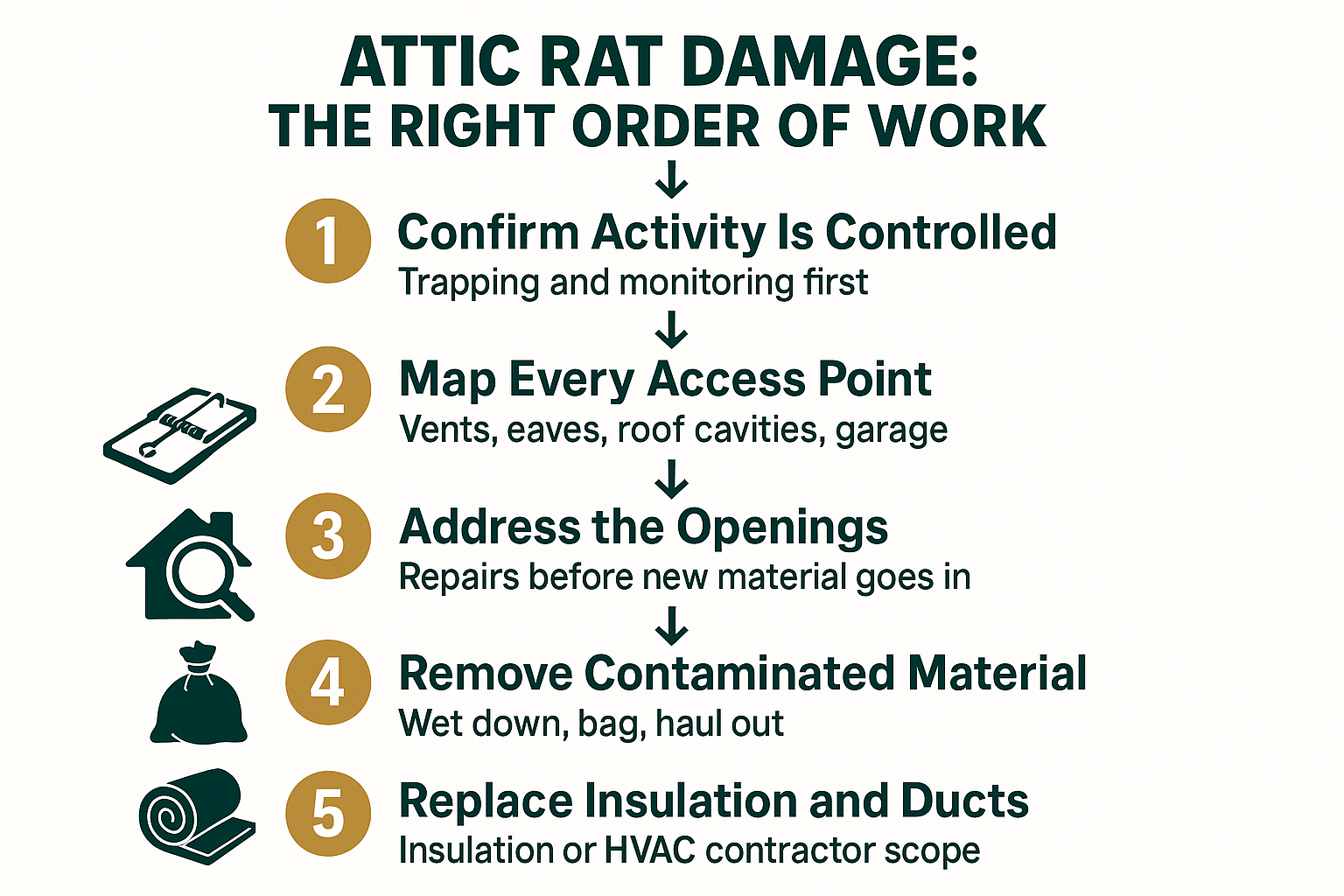
The order that keeps you from paying twice
This is the sequence I walk homeowners through, and skipping a step is the most expensive mistake in the whole process.
Why the openings come before the insulation
Replacing insulation before the activity is controlled and the access is addressed just means paying to have clean material contaminated again. I have seen it happen inside a single season.
One homeowner in the county did this the right way. She had the crawlspace and attic insulation pulled after a past rodent issue, planned the redo for fall, then asked for a rodent inspection first because she suspected activity in the garage. That is the correct sequence.
The access points that show up over and over locally:
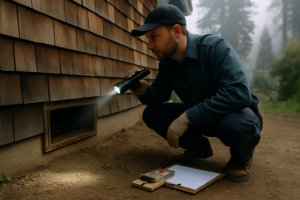
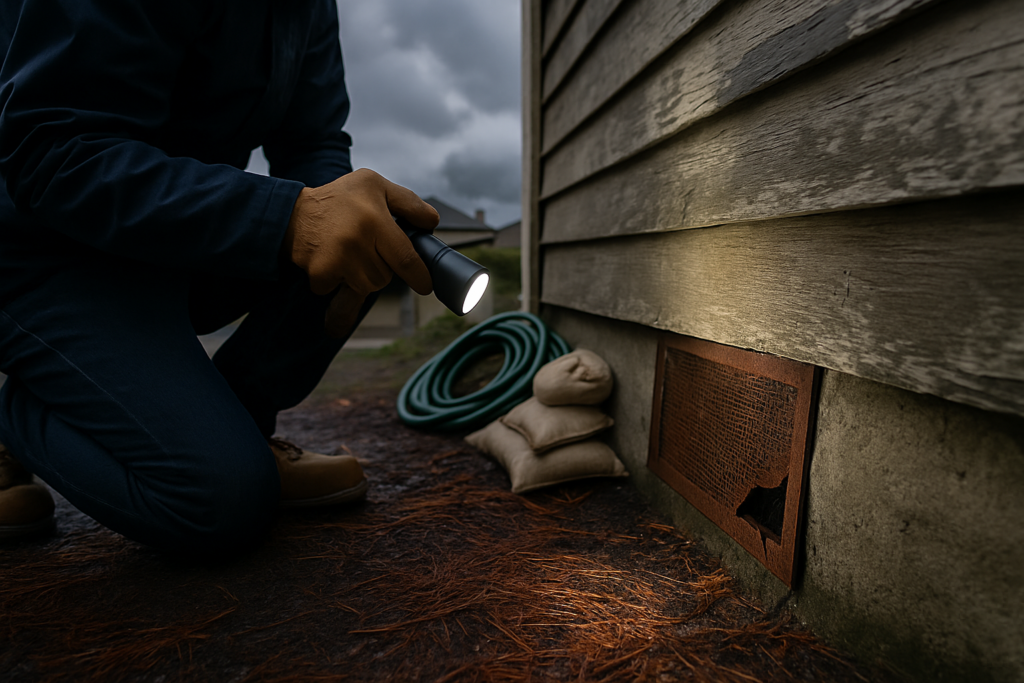
- Deteriorated crawlspace and foundation vent screens on older Pleasure Point and Westside homes
- Gaps around roof cavities, eaves, and rooflines, including where mini split lines or vents penetrate
- Detached garages and studios on mountain properties near Ben Lomond and up in the Santa Cruz Mountains, where the garage is the first stop before the house
- Utility and plumbing penetrations under the house, which then connect to wall voids and up into the attic
Be honest with yourself about the goal here. This is about reducing activity and closing off access, not clearing a property of rodents forever. Anyone who promises the second one is selling you something.
Worth knowing before you buy anything at the hardware store: California’s rules on rodent bait have changed, and that affects what a DIY approach can legally look like.
What you are looking at and what it usually means
Use this as a rough read while you are up there with a light. An in person look is what settles it.
| Where to check | What you find | What it usually means |
|---|---|---|
| Attic deck, blown in fill | Flattened runways only, no odor | Often localized removal along the trails |
| Attic deck, blown in fill | Droppings worked down into fill, strong urine smell | Full removal of the affected area, often the whole deck |
| Batt insulation | Facing torn, batts dragged into a nest pocket | Replace the affected batts, inspect adjacent bays |
| Flex duct | Outer wrap chewed, inner core intact | May be repairable, HVAC contractor call |
| Flex duct | Droppings at registers, musty air when heat runs | Replacement of affected runs is common |
| Crawlspace | Nesting under the house plus attic activity | Both spaces usually need to be scoped together |
If you are thinking about pulling it yourself
Some homeowners do handle their own insulation removal. If that is you, the safety piece is not optional.
- Do not sweep or dry vacuum droppings and nesting material. That puts dust into the air you are breathing.
- Ventilate the space before you start working in it.
- Wet the material down with a spray bottle before you disturb it.
- Wear gloves and proper respiratory protection, not a dust mask from the junk drawer.
- Bag material at the source and get it out of the house rather than dragging it through living space.
The CDC’s guidance on cleaning up after rodents covers this in more detail and is worth ten minutes of reading before you go up there.
And if the space is tight, hot, or has knob and tube wiring, hire it out. Attics in older Santa Cruz homes are not friendly places to learn.
What moves the cost up or down
This is the question everyone has and nobody wants to ask first. I will handle it as factors instead of figures, because a number without a scope behind it is meaningless.
What actually drives the price:
- Attic square footage, which is the base of every estimate
- Access, meaning a walk-in attic with decking versus a low crawl you have to belly through
- Blown in versus batt, since blown in removal is a vacuum-truck job and batts come out by hand
- How spread out the contamination is, a few runways versus the entire deck
- Whether ducting gets replaced alongside the insulation
- Whether a crawlspace is involved too, which frequently doubles the scope
Costs vary a lot house to house, so an honest answer takes someone in the space with a light. Homeowners here commonly collect two or three quotes, which I think is smart.
One tip that makes those quotes actually comparable: get the scope in writing. It should list what is being removed, what is being replaced, and who is doing which part. Without that, you are comparing numbers that describe different jobs. The same logic applies to the rodent side, and I broke down what moves rat removal pricing up or down separately.
Who does what, and what a real inspection should produce
This trips people up constantly. Rodent work and insulation or duct replacement are usually separate scopes, sometimes separate trades.
Ask a pest professional about: activity level, where the animals are getting in, how the access points connect to the attic and crawlspace, and whether the problem is still live.
Ask an insulation or HVAC contractor about: removal method, disposal, R-value of the replacement, duct condition, and repair versus replacement of specific runs.
A thorough inspection should leave you with three things:
- Photos of what is actually up there, since most people never see it themselves
- Entry points mapped, not described in vague terms
- A plain description of the contamination level, corner by corner
That last part matters more locally than it sounds. I have talked to plenty of homeowners who cycled through rotating technicians at large regional companies and never got a clear read on their own house. One left a national provider after ants kept coming back before the next scheduled visit, which tells you how much attention the property was getting.
Frequently Asked Questions About Rat Damage in Attics
Does all the insulation have to come out, or just the damaged parts?
It depends on how far the activity spread. Isolated runways and one or two nest pockets can often be addressed by removing those areas. Once droppings are worked down into the fill across the deck, or the urine odor is noticeable when you open the hatch, most contractors recommend removing the whole area.
The rats are gone but the smell is still there. Why?
Because urine soaked into porous material and never dried out. Coastal fog and humidity in Santa Cruz County keep attics and crawlspaces damp enough that the odor holds for a long time. Removing and bagging the material is what resolves it.
Can I just have new insulation blown on top of the old stuff?
I would not. You are burying contaminated material, the odor stays, and you lose the ability to see what is happening on that deck later. It also hides the access points you still need to find.
How do I know if my ducts are affected and not just the insulation?
Check the flex duct wrap for chew damage, look for droppings sitting at floor and ceiling registers, and pay attention to the smell during the first week you run the heat. Any of those three is worth an HVAC contractor’s eyes on it.
Should the rodent inspection happen before or after I schedule the insulation work?
Before. Every time I have seen it done the other way, the homeowner ended up paying to clean the same space twice. Confirm the activity is controlled and the openings are handled, then schedule the replacement.
Want a clear read on your own attic before you replace anything?
Matthew West does the inspections himself and goes into the crawlspace or attic rather than working off a clipboard at the front door. One customer put it plainly in a review, saying he “took the time to go under our house and find the source of the problem.” West Pest Co. has been voted Best Pest Control in Santa Cruz two years running (Readers Choice 2023 and 2024), holds a 5 star Google rating, and is available across Santa Cruz County at (831) 430-8402 or westpestco.com.