Direct Answer: Western blacklegged ticks are present in Santa Cruz County yards year-round, with nymphs, the stage most likely to transmit Lyme disease, peaking April through July. They concentrate in tall grass edges, leaf litter, and shaded areas where wildlife pass through.
A homeowner near Aptos reached out to us recently, she was pregnant, her dogs kept coming in from the yard with ticks attached, and she described it as a major tick issue she didn’t know how to get ahead of. She wasn’t wrong to be concerned. What she was dealing with is exactly what we see every spring and early summer throughout Santa Cruz County.
Ticks in this county are not a hiking-trail-only problem. They live in yards, particularly yards near oak woodlands, redwood forest edges, or anywhere deer and other wildlife pass through. And the tick that matters most from a health standpoint, the Western blacklegged tick, is smaller than most people expect and easy to overlook until it’s already attached.
This article focuses on what’s actually happening in your yard right now: which tick species to know, where they concentrate, what conditions make 2026 a higher-risk year, and what a professional yard treatment realistically does, and doesn’t, do.
Which Ticks Are Actually in Santa Cruz County
Santa Cruz County has three tick species worth knowing about. The Santa Cruz County Mosquito and Vector Control District actively monitors tick populations through flagging surveys along trail edges and posts public warnings when populations spike in specific areas.
The three species you’re most likely to encounter:
- Western blacklegged tick (Ixodes pacificus): The primary carrier of Lyme disease in California. Found in oak woodlands, coastal scrub, and redwood forest edges, all of which border residential neighborhoods above Aptos, Soquel, and Ben Lomond.
- Pacific Coast tick (Dermacentor occidentalis): Larger and more visible. Can transmit spotted fever but is generally considered a lower Lyme risk than the blacklegged tick.
- American dog tick (Dermacentor variabilis): Most commonly found in open grassy areas. Rare in Santa Cruz compared to the other two, but not absent.
Of these, the Western blacklegged tick deserves the most attention. It’s the smallest, the hardest to spot, and the most medically significant. And it’s the one most likely living in the leaf litter along your fence line right now.

The Life Stage That Actually Bites People, and Why It’s So Hard to Catch
Most people picture an adult tick, dark, visible, the size of a small apple seed. But the life stage most likely to transmit Lyme disease to a person is the nymph, and nymphs are roughly the size of a poppy seed.
Nymphs are active from April through July in California. That window lines up exactly with when Santa Cruz families are spending the most time outdoors, kids playing in the yard, dogs running through the back fence line, garden work picking up after winter.
Because nymphs are so small, they often go undetected long enough to feed. And a tick generally needs to be attached for 36 to 48 hours before Lyme disease transmission becomes a real risk. That window sounds generous until you realize you may not feel the bite at all.
Santa Cruz’s coastal climate, mild wet winters, moderate spring temperatures, is consistent with conditions that support strong nymph populations heading into early summer. Based on general seasonal forecasting for 2026, many California pest professionals are anticipating higher-than-average tick activity this year. That tracks with what we’re already hearing from homeowners calling in during late spring.
If you want to understand more about how long ticks can survive without attaching to a host, our separate article on how long ticks live without feeding covers that question in detail. This article is focused on what’s happening at the yard level.
Where Ticks Hide in a Typical Santa Cruz Yard
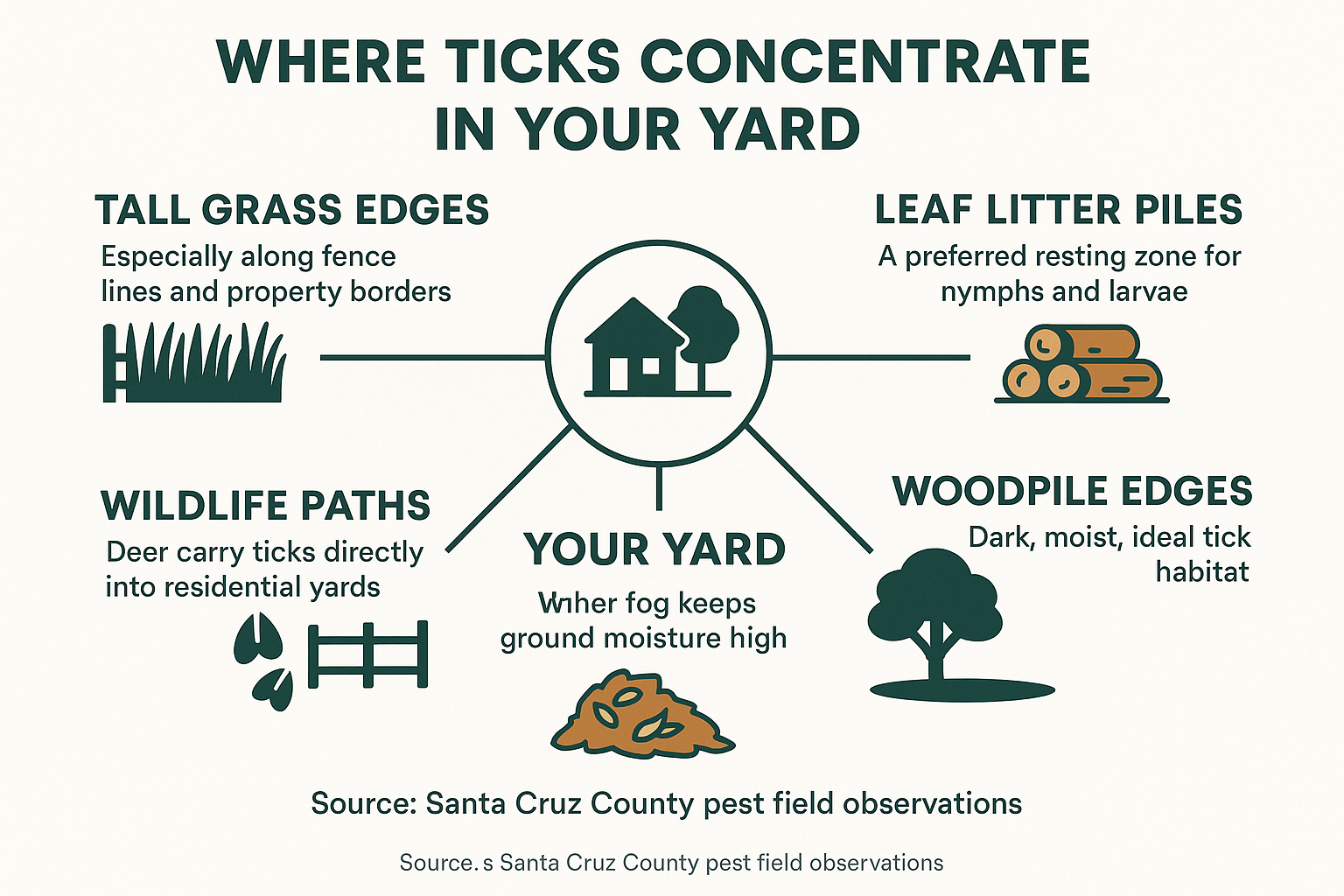
Ticks don’t spread evenly across a yard. They concentrate in specific microhabitats, knowing where those are helps you target risk and make smart decisions about treatment.
The Specific Yard Features That Create Risk
Understanding tick habitat is practical, it tells you exactly where to focus your attention, and where a treatment will do the most good.
Ticks don’t hunt. They wait, a behavior called questing, where they cling to vegetation with their back legs and hold their front legs out, ready to attach to a passing host. They concentrate where conditions are right: moisture, shade, and regular wildlife traffic.
In a typical Santa Cruz yard, the highest-risk zones are:
- Unmowed grass along fence lines, especially where your property borders a hillside, creek, or greenbelt
- Leaf litter under oak trees or along the back perimeter, which holds moisture from coastal fog long after open areas dry out
- Woodpile edges, stacked firewood is one of the most overlooked tick habitats in residential yards
- Shaded garden beds close to the house, particularly on the north-facing side where morning fog lingers
- Any path or gap where deer, raccoons, or other wildlife pass through regularly
Yards in Soquel, Ben Lomond, and the hillside neighborhoods above Capitola tend to see higher tick pressure because they back up against exactly the oak woodland and coastal scrub habitat where Western blacklegged ticks are most established.
Some simple yard modifications can meaningfully reduce exposure:
- Keep grass mowed short, particularly within 9 to 10 feet of the yard perimeter
- Remove or relocate woodpiles away from areas where kids and pets play
- Clear leaf litter regularly rather than letting it accumulate along fences and beds
- Trim low-hanging shrubs and brush that create shaded, humid ground-level zones
These aren’t guarantees, a deer that walks through at night can drop ticks regardless of what your yard looks like. But reducing habitat reduces the population that establishes and breeds on your property.
Santa Cruz County Tick Species at a Glance
Here’s a quick reference for the three tick species active in Santa Cruz County, covering their size, peak season, and the habitat where you’re most likely to encounter them.
| Tick Species | Size (Nymph) | Peak Activity | Common Habitat in Santa Cruz |
|---|---|---|---|
| Western Blacklegged Tick | ~1 mm (poppy seed) | April – July (nymph) | Oak woodland, coastal scrub, redwood forest edges |
| Pacific Coast Tick | 2-3 mm (adult) | Spring and fall | Chaparral, open woodland, trail edges |
| American Dog Tick | 1.5-2 mm (nymph) | Spring – early summer | Open grassland, meadow edges |
What a Professional Yard Treatment Actually Does
I want to be straightforward about this, because I think a lot of homeowners go into yard treatments with expectations that don’t match what the service actually delivers.
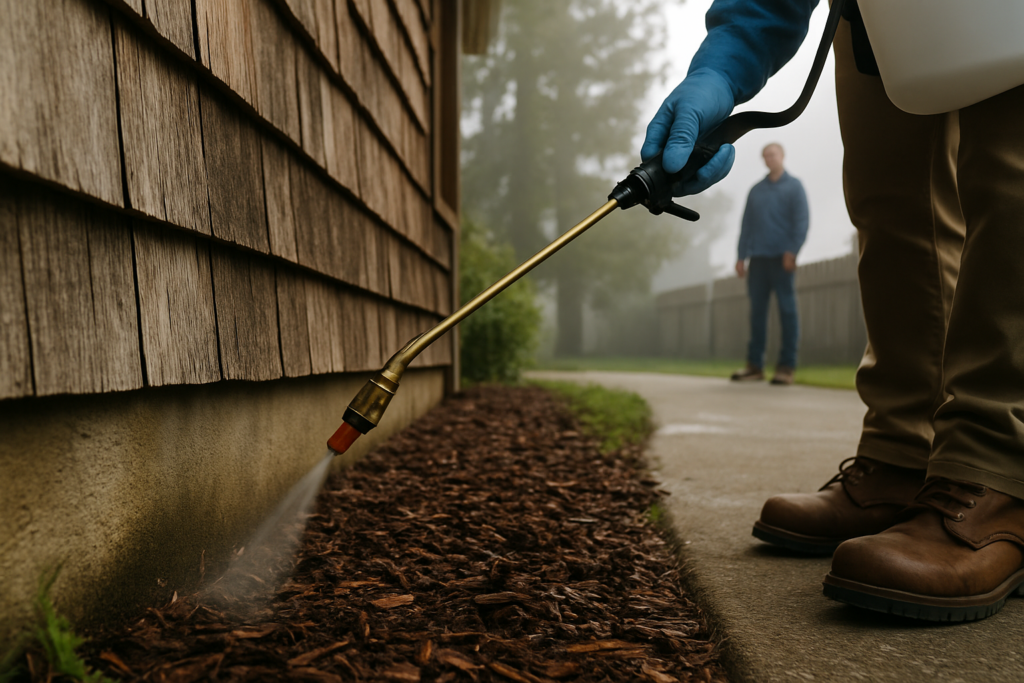
A professional flea and tick yard treatment targets active ticks in the areas where they concentrate, the perimeter zones, leaf litter edges, and shaded sections we covered above. The products used in a targeted approach are applied where ticks live, not broadcast across the entire lawn. This matters for safety around kids and pets, and it’s why understanding your yard’s specific risk zones before treatment makes a real difference.
In terms of how long a treatment holds, that depends on several factors:
- Yard size and complexity, more square footage and more shaded zones mean more area to treat
- Wildlife activity, if deer are walking through regularly, new ticks are constantly being introduced
- Time of year, treatments done during peak nymph season may need a follow-up pass as the season progresses
- Rain and fog exposure, Santa Cruz’s coastal moisture can affect how long some products stay active
For yards with ongoing wildlife pressure or significant tree canopy, a single treatment is rarely the end of the conversation. Multiple passes spaced over the active season is a more realistic plan than expecting one application to carry through summer.
Pricing for professional yard tick treatments in Santa Cruz County varies depending on yard size, site conditions, and the scope of work. From what we see in the local market, costs can range, and the best way to get an accurate number is to have someone assess the specific conditions on your property rather than quoting by square footage alone.
If you’ve also been dealing with fleas alongside ticks, which is common in yards with wildlife traffic, it’s worth reading why one flea treatment often isn’t enough to break the cycle, because the same principle applies.
Frequently Asked Questions About Ticks in Santa Cruz Yards
My dogs keep coming in with ticks. Does that mean my yard has an infestation?
Not necessarily an infestation in the traditional sense, but it does mean ticks are present and your dogs are serving as hosts. Dogs that spend time near fence lines, brush edges, or shaded zones are going to pick up ticks regularly if the habitat is right. A single dog finding ticks consistently over several weeks is a real signal that the yard warrants a professional look, especially if children also spend time in the same areas.
How small are tick nymphs really? Can I actually see them?
Western blacklegged tick nymphs are roughly 1 millimeter, about the size of a poppy seed. You can see them, but only if you’re looking carefully and in decent light. On skin with hair, they’re very easy to miss. Running your fingers over skin after time outdoors is not a reliable check. A slow, thorough visual inspection with good lighting, including the scalp, behind the ears, underarms, and behind the knees, is the only way to catch them before they feed long enough to matter.
Will a yard treatment keep ticks away permanently?
No, and any company that tells you otherwise isn’t being straight with you. Ticks are continuously reintroduced to yards by wildlife, so treatment effectiveness is always temporary. A targeted yard treatment can significantly reduce the active population in the treated zones, but ongoing wildlife activity means ongoing tick pressure. The right plan depends on how much wildlife traffic your yard sees and what your tolerance for risk looks like.
Is the treatment safe for my kids and pets?
The targeted treatments used by professionals for tick control are applied in specific zones rather than broadcast everywhere, which keeps product exposure low. Typical guidance is to keep children and pets off treated areas for a set period after application, usually until the product has dried, which is often a few hours. Matthew West uses eco-friendly, targeted approaches and will walk you through exactly what was applied and when the yard is safe to use again.
Do I need to worry about ticks in winter in Santa Cruz?
Santa Cruz’s mild coastal climate means ticks don’t die off the way they might in colder inland regions. Adult Western blacklegged ticks are actually most active in fall and winter, roughly October through March. So while nymph season peaks in spring, tick exposure is genuinely a year-round concern here. This is different from what most online resources describe, because those resources are written for colder climates.
Can I treat the yard myself with store-bought products?
Some homeowners do use retail tick sprays on their own, and they can knock down populations in limited areas. The challenge is knowing where to apply them. Without understanding where ticks concentrate on a specific property, DIY treatments often hit the wrong zones or miss the perimeter edges entirely. If you want to try it, focus on the fence line perimeter, leaf litter zones, and any areas where wildlife come in, not the open lawn. For significant pressure or yards near wooded areas, a professional assessment gives you a more accurate picture of what you’re dealing with.
Want a Professional Eye on Your Yard Before Peak Nymph Season Passes?
If you’re finding ticks on your dogs, your kids, or yourself after time in the yard, it’s worth getting a clear picture of what’s actually happening on your property before the situation grows. West Pest Co. serves homeowners throughout Santa Cruz County, from Aptos and Soquel to Ben Lomond and Scotts Valley, with targeted flea and tick treatments that account for your specific yard conditions, wildlife pressure, and the safety of everyone in your home. Reach Matthew directly at (831) 430-8402 or visit westpestco.com to get started.