Hearing scratching in the walls or finding droppings in your pantry can be unsettling. The first question is always the same: is it mice or rats? The fundamental difference is that rats are significantly larger, more cautious, and leave bigger signs of damage, while mice are small, curious, and can squeeze through dime-sized holes.
Correctly identifying your unwanted guest is the most critical step toward effective and safe rodent control for your Santa Cruz home. This guide will help you spot the differences and understand what to do next.
Quickly Identifying Mice vs Rats in Santa Cruz
When you discover a rodent problem, your immediate goal is to figure out what you're up against. Is it a small, inquisitive house mouse, or a larger, more destructive roof rat—a common nuisance in coastal communities like Aptos and Capitola?
The answer determines the right approach for removal and prevention. Because rats and mice have different behaviors, body types, and nesting habits, a one-size-fits-all solution simply doesn’t work. Knowing the key distinctions helps you and your pest control professional create a targeted strategy that actually gets results.
At-a-Glance Comparison: Mice vs. Rats
To make things easier, here is a quick reference table. It breaks down the key physical and behavioral differences between the common house mice and rats we see all over Santa Cruz County.
| Feature | House Mouse (Mus musculus) | Roof Rat or Norway Rat (Rattus spp.) |
|---|---|---|
| Size (Body) | Small, 2-4 inches long | Large, 7-10 inches long |
| Weight | About half an ounce | Can be over one pound |
| Ears | Large and floppy relative to its head | Small and thicker, proportional to its head |
| Tail | Long, thin, and slightly hairy | Thick, scaly, and shorter than its body (Norway) or longer (Roof) |
| Droppings | Small (1/8 inch), pointed like grains of rice | Large (1/2-3/4 inch), with blunt or rounded ends |
| Behavior | Curious; will investigate new objects | Cautious (neophobic); avoids new objects in its path |
| Nesting Site | Inside walls, behind appliances, in cluttered areas | Attics, rafters, wall voids (Roof Rats) or burrows (Norway Rats) |
| Diet | Prefers cereals, grains, and seeds; nibbles on many sources | Omnivorous; eats anything from meat and pet food to trash |
Think of this table as your field guide for figuring out what you’re dealing with. A quick look at the droppings or a fleeting glimpse of a tail can often be enough to tell you whether you have a mouse or a rat problem.
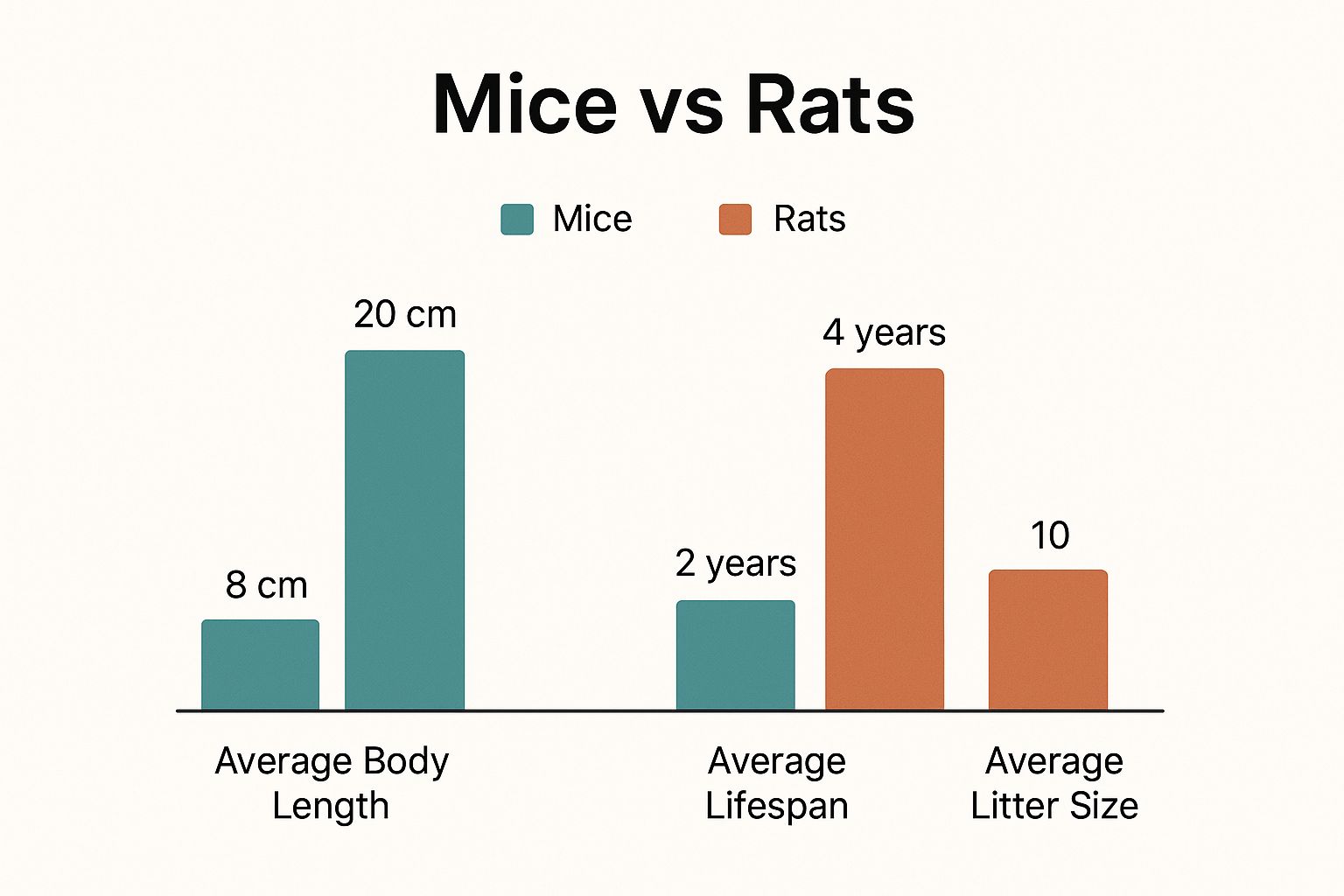
This image illustrates a critical point: it's not just about size; it's about reproductive power. According to university research, a single female rat can produce up to 12 litters of 6-12 pups per year under ideal conditions (University of California, 2018).
This means a single rat issue can escalate into a major infestation much faster than a mouse problem. While both rodents reproduce at an alarming rate, the breeding capacity of rats underscores the urgency of addressing an infestation the moment it's discovered.
A Detailed Comparison of Rodent Appearance
While size is the most obvious giveaway, a closer look at a rodent’s physical features provides the definitive proof you need when telling mice and rats apart. It's especially useful for identifying a juvenile rat, which many homeowners mistake for an adult mouse.
Getting the identification right is the foundation of any successful pest control plan. Let’s break down the key traits that distinguish these two common invaders, from their head shape right down to the tip of their tail.
Head and Snout Shape
One of the most reliable ways to tell them apart is by looking at the rodent’s head and snout. A mouse has a small, distinctly triangular head with a pointed nose, giving it a sharp, almost delicate profile.
A rat, in contrast, has a much blunter and more robust snout. Whether it's the stocky Norway rat or the sleeker roof rat common in the coastal climate of Santa Cruz County, its head looks broader and heavier. This powerful head structure supports stronger jaws that can gnaw through much tougher materials.
Ears and Eyes
A rodent's ears offer another clear visual clue. A mouse's ears are remarkably large and floppy in proportion to its small head, almost like oversized satellite dishes. They are thin and prominent.
Rats, on the other hand, have ears that are smaller, thicker, and more proportional to their larger heads. Their ears don't stand out as dramatically as a mouse's do.

Tail and Feet
Perhaps the most telling difference lies in the tail. A mouse's tail is long, thin, and covered in a fine layer of barely visible hairs. It’s generally the same length as its body and acts as a tool for balance.
A rat’s tail is a stark contrast. It is thick, heavy, and scaly, often appearing hairless. The tail of a Norway rat is typically shorter than its body, while the roof rat—an agile climber often found in Aptos and Capitola—has a tail that is longer than its body.
A young rat's head and feet will appear disproportionately large for its body, while an adult mouse is much more evenly proportioned. This is the best way to distinguish a baby rat from a full-grown mouse.
Putting It All Together for Effective Control
Telling these features apart is more than just a biology lesson; it’s a critical step toward reclaiming your home. The small body of a mouse requires sealing tiny gaps, while the larger, stronger build of a rat calls for reinforcing more substantial entry points.
If you're struggling to identify the rodents on your property, a professional inspection can provide clarity and peace of mind. For a complete overview of how we handle these pests, you can learn more about our professional rodent control and prevention services in Santa Cruz County.
Understanding Rodent Behavior and Nesting Habits
Where a rodent decides to eat, hide, and build its nest tells you everything you need to know about what you're dealing with. The behavioral differences between mice and rats are just as telling as their physical appearances.
The most critical behavioral split is how they react to new things in their environment. Mice are defined by their curiosity. They will boldly explore new objects, which is why you’ll often find them nesting very close to food sources inside your home.
Rats, on the other hand, are creatures of neophobia—a deep-seated fear of anything new. They stick to familiar, hidden pathways along walls, pipes, and rafters. This cautious nature makes them significantly harder to control without a professional strategy.
Nesting Preferences: Mice vs. Rats
The type of rodent you have almost always dictates where you'll find the nest. Their preferred locations are a direct result of their physical abilities and instincts.
- Mice: Thanks to their small size and inquisitive nature, mice build nests in secluded, warm spots close to food. Common nesting sites include wall voids, behind kitchen appliances, in cluttered garages, and tucked into attic insulation.
- Rats: Roof rats, the most common species in Santa Cruz County's coastal climate, are exceptional climbers. They seek higher ground, establishing nests in attics, rafters, palm trees, and thick ivy. Norway rats, while less common here, prefer to burrow underground or in lower levels like crawl spaces.
The location of a nest is one of your best clues. Scratching from the attic strongly suggests roof rats, while faint scurrying from within the walls or behind the fridge is a classic sign of mice.
Distinct Feeding Styles
Another crucial difference is how they eat. This knowledge helps you interpret the evidence you find and is essential for effective baiting and trapping.
A mouse is a nibbler. It eats tiny amounts of food from many different locations throughout the night, sampling a little here and there. This is why you might find small gnaw marks on several food packages in your pantry.
In contrast, a rat is a voracious eater. It prefers to eat a large meal from just one or two reliable food sources. If they find an unsecured bag of pet food, they will return to that same spot again and again.
Knowing whether your pest is a curious nibbler or a cautious feaster dictates the entire control strategy. For a deeper dive, review our guide on the best rodent prevention plan for Santa Cruz residents.
This behavioral knowledge also helps explain how a small problem can escalate. Under normal conditions, house mouse populations are low, but during rare outbreaks, densities can surge by more than 1,000 times, as seen in agricultural areas. You can learn more about house mouse population dynamics from this research.
Recognizing the Telltale Signs of an Infestation

While you may not see the culprit, rodents always leave a trail of evidence behind. Learning to read these clues is the first step in diagnosing your pest problem and understanding its scale.
Since the signs left by mice and rats are so different, identifying the evidence is often far easier than spotting the animal itself. Knowing what to look for helps you act quickly and get the right solution in place.
The Most Obvious Clue: Droppings
The most common and definitive sign of a rodent problem is their droppings. The size and shape are immediate giveaways, telling you exactly which pest has moved in.
- Mouse Droppings: These are small pellets, usually about 1/8 to 1/4 inch long. They have pointed ends and look a lot like grains of black rice. You’ll find them scattered around high-traffic areas like along baseboards or inside kitchen drawers.
- Rat Droppings: Rat droppings are much larger, measuring 1/2 to 3/4 of an inch long with blunt, capsule-shaped ends. Unlike mice, rats tend to leave their droppings in more concentrated piles.
Destructive Gnaw Marks
Both mice and rats have incisors that grow continuously, which means they must gnaw on things to keep them filed down. The damage they leave behind, however, looks very different.
A mouse’s teeth are tiny, creating marks that look more like light scratches or small scrapes. You might find this damage on cardboard boxes, soft plastics, or wooden baseboards.
Rats, on the other hand, have incredibly powerful jaws that leave behind much more significant damage. Their gnaw marks are rough, deep gouges. They can chew straight through:
- Structural wood and beams
- PVC pipes and electrical conduits
- Drywall and even aluminum siding
- Soft metals like lead or copper
This destructive gnawing makes a rat infestation a serious threat to your home’s structural integrity.
A key sign of rats—and only rats—are the greasy, dark smudges they leave along walls or ceiling rafters. These "rub marks" come from the dirt and oils on a rat's fur as it uses the same hidden pathway repeatedly. Mice are too small and clean to leave these distinctive marks.
To help you put all the pieces together, here’s a quick breakdown of the evidence you might find.
Evidence Breakdown: Mouse vs. Rat Infestation
| Type of Sign | Evidence From a Mouse | Evidence From a Rat |
|---|---|---|
| Droppings | Small (1/8-1/4"), pointed, scattered like seeds. | Large (1/2-3/4"), blunt, found in piles. |
| Gnaw Marks | Tiny scratches, light scrapes on soft materials. | Deep, rough gouges on wood, plastic, even metal. |
| Rub Marks | None. They are too small and clean. | Greasy, dark smudges along walls and travel paths. |
| Sounds | Faint scratching, light scurrying in walls/ceilings. | Loud gnawing, dragging, squeaking from attic/crawlspace. |
For a definitive answer and to understand the full scope of a potential problem, scheduling a professional evaluation is the safest next step. A thorough home pest inspection in Santa Cruz will uncover all the hidden evidence and provide the foundation for a targeted pest control plan.
Health Risks and Property Damage Threats
Having rodents in your Santa Cruz home is more than just a nuisance—it’s a direct threat to your family's health and your home's integrity. Both mice and rats are known carriers of disease and can cause serious destruction.
The most immediate danger is contamination. As mice and rats scurry through your kitchen and living areas, they leave behind a trail of droppings, urine, and saliva. This trail is a highway for pathogens that can lead to serious illnesses.
The Dangers Hiding in Your Home
While any rodent is a health risk, rats are generally considered the more significant threat because of the severe diseases they carry.
- Shared Health Risks: Both mice and rats are notorious for spreading dangerous bacteria like Salmonella and viruses such as Hantavirus. You can get sick from direct contact with their waste or even by breathing in airborne particles from dried droppings in enclosed spaces.
- Rat-Specific Diseases: Rats are known vectors for more severe illnesses, including Leptospirosis (a bacterial infection spread through their urine) and even rat-bite fever. This alone makes a rat infestation a much higher-stakes problem.
A Costly Comparison of Property Damage
Beyond health issues, the physical damage rodents cause can be extensive and expensive to fix. Their incisors never stop growing, forcing them to chew constantly.
Mice, with their smaller teeth, tend to stick to softer materials. They might chew through cardboard food boxes, shred insulation for nesting, or gnaw on electrical wiring—a serious fire hazard.
Rats, on the other hand, are equipped with powerful jaws that can cause severe structural damage. They are capable of:
- Destroying structural wood beams and supports.
- Gnawing straight through PVC pipes, causing leaks and mold growth.
- Shredding electrical wiring, creating a major fire risk.
The powerful jaws of a rat can destroy materials a mouse could never penetrate, including soft metals like lead and aluminum. This ability to compromise foundational elements of a home makes a rat problem particularly dangerous.
The financial fallout from rats is staggering. It's estimated that rats cause about $19 billion in damages worldwide each year. You can read more about their global impact in this in-depth research on Rattus norvegicus.
Because these health and safety risks are so severe, you must address any rodent issue fast. If you're worried about a potential infestation, exploring professional pest control services in Santa Cruz is the surest way to protect your home and your family.
Your Guide to Effective Rodent Control and Prevention

Once you know whether you're dealing with mice or rats, the next step is building a smart control plan. The strategies for each are worlds apart because their behaviors are so different.
Effective mouse control centers on their tiny size and curious nature. The main goal is exclusion—meticulously finding and sealing dozens of small entry points, some no bigger than a dime. Because mice are naturally inquisitive, traps can be placed directly in their known paths for quick results.
Rat control is a completely different ballgame. It demands a strategy for securing larger entry points while also overcoming their intense neophobia. Just plopping a trap down in a rat’s runway will only make them avoid that area. Success with rats takes patience. You can dive deeper into these strategies in our guide on how to keep rats away from your property.
The West Pest Co. Approach to Rodent Control
At West Pest Co., we use the Integrated Pest Management (IPM) approach. This modern method focuses on long-term prevention, not just reacting to infestations. It’s a smarter, more sustainable way to protect your home.
Our process always starts with a comprehensive inspection to get the full picture of the unique pressures on your property, from the coastal conditions in Capitola to the wooded areas of Scotts Valley.
An effective IPM plan doesn’t just get rid of the current intruders; it builds a lasting barrier to keep future pests out. This means identifying their food sources, sealing up entry points, and changing the environment to make your home far less appealing to them.
Our IPM strategy is a multi-step process:
- Thorough Inspection: We pinpoint the rodent species, find their nests, and map out their travel routes.
- Exclusion and Sealing: We locate and seal every potential entry point, from tiny foundation cracks to unsecured roof vents.
- Targeted Trapping: We use species-specific trapping methods that work with the rodent's behavior—either playing on a mouse's curiosity or patiently acclimating a cautious rat.
- Sanitation and Cleanup: After the rodents are gone, a deep clean is non-negotiable. An expert air duct cleaning and sanitizing guide shows how critical it is to remove pathogens from your ventilation system.
This detailed process ensures your rodent problem is solved for good. By tackling the root causes instead of just the symptoms, we give you a lasting solution and the knowledge to keep your home protected.
Frequently Asked Questions About Rodent Problems
Homeowners in Santa Cruz County often have a lot of questions once they suspect a rodent problem. Here are expert answers to some of the most common concerns we hear from local residents.
Can I have both mice and rats at the same time?
It’s incredibly unlikely. Rats are larger, more aggressive, and extremely territorial. They view mice as competition for food and will not hesitate to kill—and even eat—them to claim a territory.
If you find evidence that points to both, it's more likely they have carved out separate territories on your property. For example, you could have roof rats in the attic and a family of mice living inside the kitchen walls. A professional inspection is the only sure way to know what’s going on.
Why aren’t my store-bought rat traps working?
This is a classic frustration, and the answer comes down to rat psychology. Rats have a strong instinct called neophobia—a deep-seated fear of anything new in their environment. When you suddenly place a trap in their path, their survival instincts scream "danger," and they'll avoid it.
Effective trapping is more about outsmarting the rat than just setting a device. Professionals often place unset traps for a while, letting the rats get comfortable with the new object before arming them. This is a critical reason professional help is so valuable for rat control.
What is the best way to keep rodents from coming back?
The only real long-term solution is exclusion. This means methodically rodent-proofing your home by finding and sealing every potential entry point. For a mouse, that’s any hole the size of a dime; for a rat, it’s a gap as small as a quarter.
Key prevention strategies also include:
- Keeping strict sanitation by storing all food in gnaw-proof, airtight containers.
- Making sure all trash cans have tight-fitting lids.
- Trimming back vegetation like ivy or tree branches that touch your roofline.
Our service always includes a full inspection and a detailed list of these essential exclusion tactics.
Are rodents a bigger problem in Santa Cruz during a certain season?
While our mild coastal climate means rodents are a year-round threat, activity absolutely spikes in the fall and winter. As temperatures drop in places like Scotts Valley and Felton, and wild food sources become scarce, both mice and rats look for warmth, shelter, and a reliable meal inside our homes.
The best defense is to be proactive in the late summer, sealing up your home before they even start their search for a way in.
Why did a rat chew my car wires?
This is a common and expensive problem for car owners in Santa Cruz. The soy-based insulation used in the wiring of many modern cars is attractive to rats and other rodents. To them, it's just another source of food and material to gnaw on. Parking in a garage and keeping the area clean of food debris can help reduce the risk.
Don't let rodents compromise the health and safety of your Santa Cruz home. For a professional inspection and a lasting, eco-friendly solution, trust the local experts at West Pest Co.
Schedule your free estimate today!