Let’s get straight to the point: do foggers work on bedbugs? If you ask any seasoned pest control expert, you’ll get a firm and resounding no. These products, which you might know as “bug bombs,” are widely seen as not just ineffective but can actually make a tough situation even worse.

Why Foggers Fail The Bed Bug Test
When you discover you have bed bugs, grabbing a total-release fogger can feel like a powerful and logical first step. The idea of unleashing a cloud of insecticide to wipe out every last bug in the room is definitely appealing. Unfortunately, the reality just doesn’t line up.
The failure of these products isn’t just an opinion floating around the industry—it’s backed by solid science. A well-known 2012 study tested three different over-the-counter bug bombs against five unique bed bug populations. The result? They caused little to no deaths.
This is because foggers have two fundamental flaws when it comes to how bed bugs live and behave. If you’re curious about the specifics, you can learn more about how researchers tested bug bombs against bed bug infestations.
The Inability To Penetrate Hiding Spots
First, let’s talk about simple physics. Bed bugs are masters of concealment, cramming themselves into the tiniest cracks and crevices you can imagine. They’re deep inside mattress seams, tucked behind baseboards, and hidden away in wall voids.
A fogger releases a fine mist that drifts down and settles on open, horizontal surfaces.
Key Takeaway: The insecticide from a bug bomb almost never reaches the protected hideouts where bed bugs actually live, breed, and lay their eggs. It’s like trying to wash your hands by only letting water run over your shoulders—the important parts are left completely untouched.
The Widespread Issue Of Chemical Resistance
But here’s the kicker: even if the mist could reach them, most modern bed bugs would probably just shake it off. Decades of being exposed to common insecticides have bred populations with powerful genetic resistance.
The active ingredients in most foggers—usually pyrethroids—are often the very chemicals these resilient pests have built up a tolerance to. Using one is like trying to open a modern high-security lock with an old, bent key. It just doesn’t work anymore.
This combination of poor penetration and high resistance makes foggers a terrible investment of your time, money, and hope. Instead of solving your problem, they create a false sense of security while the real infestation continues to grow, completely undisturbed, in all those hidden spots.
To put it simply, here’s a quick breakdown of why these products don’t make the cut for bed bug control.
Why Bed Bug Foggers Fail: A Quick Summary
| Reason for Failure | What This Means for You |
|---|---|
| Poor Penetration | The mist settles on open surfaces, failing to reach the cracks and crevices where 90% or more of the bed bugs are hiding. |
| Repellent Effect | Instead of killing them, the chemicals can actually cause bed bugs to scatter and spread to other rooms, worsening the infestation. |
| High Chemical Resistance | Many bed bug populations are now genetically resistant to the pyrethroids commonly used in OTC foggers, making them ineffective. |
| No Residual Effect | Foggers don’t leave a lasting residue, so they have no impact on eggs that hatch after the fog has settled. |
| False Sense of Security | You might think the problem is solved, which delays you from seeking effective treatment while the infestation quietly grows. |
In the end, relying on a fogger is a gamble that almost never pays off. It’s a frustrating dead-end that leaves you right back where you started, only with more bed bugs than before.
Why Foggers Can’t Reach Hiding Bed Bugs
To get why foggers almost always fail against bed bugs, picture this: you need to paint an entire room, but instead of using a roller, you just stand in the middle, spray a can of paint in the air, and hope for the best.
What happens? You’ll get a nice coat of paint on the floor and maybe the tops of some furniture. But the walls, the ceiling, and anything tucked away on a shelf would be completely untouched. That’s the core problem with bug bombs.
They release a fine, aerosolized mist that simply follows gravity, drifting downward. The insecticide particles settle on whatever is exposed and horizontal—the top of your mattress, the floor, the surface of your dresser. It might look like you’ve covered everything, but it’s a dangerously superficial treatment.
The Instinct for Deep Harborages
Bed bugs are not out-in-the-open creatures; they are masters of concealment. Their entire survival strategy is built around finding the tightest, most protected cracks and crevices they can squeeze into. Think of them as tiny survivalists who know that being seen means being dead. They spend the vast majority of their lives crammed into tiny spaces a floating mist could never dream of entering.
These preferred hiding spots, or harborages, are precisely where foggers can’t go:
- Inside mattress seams and box springs: The tiny folds and stitching provide perfect, undisturbed cover.
- Within cracks in the bed frame and headboard: Their flat bodies are designed to slide into the narrowest of gaps.
- Behind baseboards and peeling wallpaper: These spots offer dark, quiet shelter right next to their food source—you.
- Inside electrical outlets and wall voids: They can even retreat deep into the very structure of your home.
This visual breaks down the complete disconnect between where a fogger sprays and where a bed bug lives.
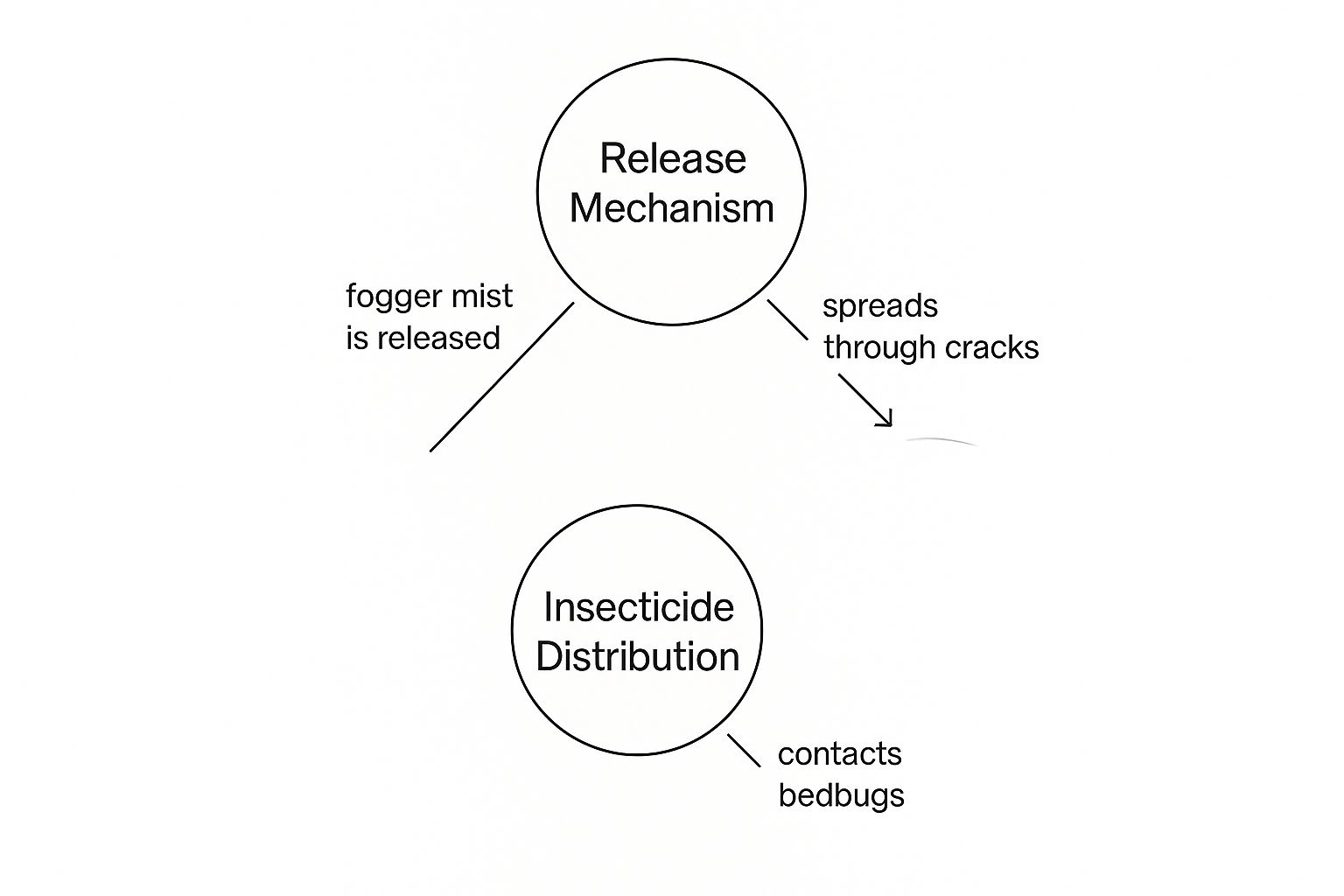
As the infographic shows, the insecticide cloud hangs in the open air, failing to make any meaningful contact where it actually counts.
A Mismatch of Method and Biology
At its heart, the issue is a total mismatch between the tool and the target. A fogger’s mist has no pressure, no directional force. It can’t penetrate deep into hiding spots. The insecticide just settles on the surface, leaving the bed bugs inside perfectly safe and sound.
The Critical Flaw: A bug bomb treats the room, not the pest. Because the insecticide doesn’t reach where bed bugs actually live and breed, it simply cannot kill them. It’s the wrong strategy for a pest that has evolved to avoid exactly this kind of widespread, non-targeted attack.
This is precisely why professionals give a hard “no” when asked if foggers work on bed bugs. Any truly successful treatment has to deliver the product directly into the cracks and crevices where they’re hiding. Since foggers are physically incapable of doing this, they fail to solve the real problem, leaving you with a false sense of security while the infestation continues to grow.
The Reality of Insecticide Resistance
Even if a fogger’s mist could magically seep into every last crack and crevice, you’d still face a massive problem: today’s bed bugs are just incredibly tough. They’ve essentially become the supervillains of the pest world, armed with a powerful genetic resistance to the very chemicals designed to kill them.
It works just like antibiotic resistance in bacteria. For decades, the widespread use of certain insecticides has created an unintentional breeding program for stronger bed bugs. The weak ones died off, but the tough survivors passed their resistant genes down, creating new generations that can simply shrug off a chemical attack.
This evolutionary arms race is a huge reason why your search for “do foggers work on bedbugs” keeps leading to a firm “no.” The main active ingredients in most over-the-counter foggers are pyrethroids, a class of insecticide that modern bed bugs have become almost completely immune to.

The Science of Survival
This isn’t just an idea; it’s a well-documented scientific fact. Current entomological research paints a pretty stark picture: an estimated 90% of bed bugs around the world have developed resistance to the insecticides commonly found in foggers and bug bombs. Through rapid evolution, these pests have developed traits that make them largely immune to pyrethroids. The poison just doesn’t work anymore. You can read more about why fogger chemicals fail against bed bugs and see how experts have documented this resistance.
Using a standard fogger today is like trying to open a high-tech digital lock with an old-timey skeleton key. It’s not just an ineffective tool; it’s an obsolete one against an enemy that has completely outsmarted our old methods.
The Hard Truth: You could expose a resistant bed bug directly to the mist from a fogger, and it would likely crawl away unharmed. Their bodies have built-in defenses, like thicker shells or enzymes that neutralize the poison before it can do any damage.
Why Resistance Makes Foggers Counterproductive
This built-in resistance doesn’t just make foggers useless—it can actually make your problem worse. Here’s how:
- You Only Kill the Weakest Bugs: At best, a fogger might take out the small fraction of non-resistant bugs in the population. This leaves the strongest, most-resistant “super bugs” with no competition, free to reproduce and create an even tougher infestation.
- It Gives You a False Sense of Security: Finding a few dead bugs can trick you into thinking the fogger worked. But in reality, the vast majority of the population is still hiding, unharmed, and multiplying while you believe the problem is solved.
- It Wastes Critical Time: Every single day you delay an effective treatment, the bed bug population grows. Wasting a week on a failed fogger attempt gives them precious time to breed and spread even further throughout your home.
When it comes down to it, the chemical resistance of modern bed bugs is the final nail in the coffin for foggers. Combine their inability to penetrate hiding spots with the fact that the chemicals are ineffective even on direct contact, and it becomes crystal clear: bug bombs are a dead-end street.
The Hidden Dangers of Using Bug Bombs
It’s a common misconception that bug bombs, at worst, are just a waste of money. The unfortunate truth is they can do far more harm than good, turning a contained bed bug problem into a full-blown, property-wide nightmare.
Here’s the problem: the chemicals in a fogger act more like a powerful irritant than a lethal poison. Instead of killing the bed bugs, the mist sends them into a panic. They flee the area, scattering deep into wall voids, under carpets, and even into neighboring rooms or apartments.
This is exactly how a single-room issue explodes into an infestation that’s significantly harder—and more expensive—to treat. Research has confirmed that foggers can push bed bugs into other units, creating a much bigger crisis. Despite these findings being shared with the Environmental Protection Agency, a major gap still exists between what the products claim and how they actually perform. You can check out the research on fogger ineffectiveness for yourself.
Escalating Infestations and Health Risks
This scattering effect is the biggest danger of using a fogger. An infestation that a professional could have easily contained in one bedroom is now a major headache. We end up hunting for smaller, scattered pockets of bed bugs across multiple rooms, which takes more time, more materials, and ultimately, more of your money.
On top of making the pest problem worse, bug bombs bring serious safety hazards into your home. The aerosol propellants are often highly flammable. If that mist makes contact with a pilot light from a stove, furnace, or water heater, it can trigger a fire or even an explosion.
Crucial Warning: The chemicals in these foggers are anything but harmless. They can cause respiratory issues, trigger asthma attacks, and leave a nasty chemical residue on your floors, furniture, and personal items long after the mist settles. You and your family end up living with that exposure.
The True Cost of a Failed DIY Attempt
When you add it all up, the answer to “do foggers work on bedbugs?” becomes painfully clear. They don’t just fail to kill the pests; they actively spread them around your home while introducing fire and health risks you didn’t sign up for.
The initial cost of a few bug bombs is nothing compared to the eventual price tag of a multi-room treatment or, worse, repairing fire damage. For anyone looking for a genuinely effective and safer alternative, exploring professional eco-friendly pest control treatments is a much smarter and more responsible path to take.
Proven Bed Bug Strategies That Actually Work
Now that we’ve pulled back the curtain on why bug bombs are such a letdown, let’s talk about what actually gets rid of bed bugs for good. The reality is, there’s no single magic bullet. Real, lasting control comes from a smart, multi-layered strategy that pros call Integrated Pest Management (IPM). This is the gold standard for a reason—it combines different tactics to attack the infestation from every possible angle.
Think of it less like dropping a single bomb and more like a coordinated ground assault. Instead of a “spray and pray” approach, IPM is precise and intelligent. It uses the bed bugs’ own biology and behavior against them, ensuring every treatment hits exactly where it will hurt them most. This approach is not only far more successful but also significantly safer for your home and family.
The Power of Non-Chemical Controls
A huge part of any successful IPM plan relies on non-chemical tools that physically kill or trap bed bugs. These methods are absolute game-changers because bed bugs can’t develop resistance to them. They form the critical first wave of attack, drastically cutting down the population before any chemical treatments are even on the table.
Some of the most effective non-chemical strategies include:
- Targeted Steam Heat: Professionals use commercial-grade steamers to blast lethal heat (over 120°F) directly into mattress seams, bed frames, furniture joints, and baseboards. This superheated steam penetrates deep into the tiny cracks and crevices where bed bugs hide, killing adults, nymphs, and eggs instantly on contact.
- Thorough Vacuuming: A high-powered vacuum with a crevice tool is an essential weapon. It physically sucks up live bugs and their eggs from carpets, upholstery, and cracks. It’s a straightforward but incredibly effective way to immediately reduce the number of pests.
- Protective Encasements: High-quality, bite-proof mattress and box spring encasements are non-negotiable. These zippered covers trap any bed bugs left on your mattress inside, where they’ll eventually starve. Just as importantly, they prevent any new bugs from making a home in your bed.
Key Insight: These non-chemical methods directly solve the problems that make foggers fail. They are targeted, they penetrate deep into hiding spots, and they eliminate all life stages of bed bugs without scattering them or relying on weak chemicals.
Strategic and Limited Chemical Use
While non-chemical methods do the heavy lifting, professional-grade chemical treatments still have a crucial role to play. The key difference? Unlike the reckless broadcast spray of a fogger, these are applied with surgical precision. The goal is to create a lasting, deadly barrier in the hidden pathways bed bugs use to travel.
The most common and effective tools in the professional chemical arsenal are residual dusts and liquids:
- Residual Insecticidal Dusts: Products like silica gel or diatomaceous earth are applied as a fine powder deep inside wall voids, behind electrical outlets, and under baseboards. These dusts work mechanically—they cling to a bug’s exoskeleton and destroy its protective waxy layer, causing it to dehydrate and die. As long as the dust stays dry, it remains effective for a very long time.
- Targeted Liquid Insecticides: Professionals use special non-repellent liquid insecticides that are carefully applied only into cracks and crevices. Because the formula is non-repellent, bed bugs crawl right through the treated zones without sensing any danger, unknowingly picking up a lethal dose that they can even spread to others in their hiding spots.
By combining these strategies, you get a comprehensive plan that leaves no stone unturned. It’s a methodical, intelligent approach that delivers real results—a world away from the single, flawed strategy of a bug bomb. For those looking to keep their home safe long-term, learning more about preventative pest control offers valuable insight into securing your home after an infestation is gone.
Knowing When to Call a Pest Control Professional
Relying on DIY methods can feel empowering, but with bed bugs, there’s a definite tipping point—a moment where the problem outgrows home remedies and flat-out demands professional intervention. Knowing when you’ve hit that limit is the key to saving yourself months of stress, wasted money, and sleepless nights.
If you’ve vacuumed, steamed, and laundered everything in sight but the bites keep coming back, that’s a huge signal. A recurring issue almost always means you’re missing the core of the infestation—the hidden spots where eggs are hatching and the population is quietly rebounding.
Signs You Have Reached the Tipping Point
Another major red flag is seeing bed bugs in more than one room. Once they migrate from the primary bedroom to the living room couch or a child’s bedroom, the problem has become far more complex. This is when a strategic, professional approach is no longer a luxury but a necessity.
Consider these clear signs that it’s time to pick up the phone:
- Recurring Infestations: Despite all your hard work cleaning and treating, the bugs reappear after a few weeks.
- Bugs in Multiple Rooms: Discovering bed bugs on furniture outside the main bedroom is a sure sign of a spreading, established problem.
- Overwhelm and Frustration: If the battle feels endless and it’s taking a serious toll on your mental well-being, it’s time to call in reinforcements.
The Professional Advantage: A pest control expert doesn’t just bring experience; they show up with equipment and materials completely unavailable to the public. This includes commercial-grade steamers, specialized residual dusts, and even whole-room heat treatments that can raise a room’s temperature to levels lethal for bed bugs.
Ultimately, trying to tackle a large-scale infestation on your own is like trying to put out a house fire with a garden hose. You might get a small spot, but you simply don’t have the power to stop it at the source. By recognizing these signs early, you can keep the problem from spiraling out of control. When you’re ready for a real solution, getting help from a pro pest control company is the single most effective step you can take.
Frequently Asked Questions About Bed Bug Control
Learning that the answer to “do foggers work on bedbugs” is a hard no can be frustrating. It’s natural to feel a bit lost and wonder what to do next. We’ve put together answers to the most common questions we hear to help you create a plan that actually works.
If I Already Used a Fogger What Should I Do?
First, don’t panic. The most important thing to do right now is to thoroughly ventilate the room, following the directions on the product label. You need to clear out all those lingering chemicals.
Since the fogger almost certainly scattered the bugs rather than killing them, your immediate next step is a detailed inspection. Check every area surrounding the room where you set off the bomb. From there, it’s time to pivot to methods that work: thoroughly vacuum all carpets, furniture, and crevices. Get a high-heat steamer and hit the mattress seams, box spring, and bed frame. Finally, gather all bedding, curtains, and clothing and wash them in the hottest water the fabric can handle.
Are Bug Bombs Good for Any Type of Pest?
While they are completely useless against pests that hide in cracks and crevices, like bed bugs and cockroaches, foggers can have some limited effect. They might knock down exposed flying insects like house flies, but only in a small, sealed room. For bed bugs, they are simply the wrong tool for the job.
The two main reasons they fail are simple: the aerosol mist is too fine to penetrate the tiny cracks where bed bugs live, and many bed bug populations have developed a strong resistance to the chemicals used in them. It’s a classic case of needing to match the treatment to the pest’s biology.
How Can I Tell If My Bed Bugs Are Resistant?
Unfortunately, there’s no way for a homeowner to know for sure just by looking at them. The most practical and safest approach is to just assume they are resistant from the start.
The most definitive sign of resistance is treatment failure. If you’ve applied a DIY product correctly and still see live bugs a week later, pesticide resistance is the most probable culprit.
And if you’re not even sure if bed bugs are the problem, identifying mysterious bites is a crucial first step before you do anything else.
When DIY efforts fail and the infestation just won’t go away, it’s time to call in professional expertise. For reliable and effective solutions in Santa Cruz County, trust the experts at West Pest Co. to eliminate your bed bug problem for good. Get a free estimate today.