Direct Answer: Starting January 1, 2027, counties may charge pest control businesses up to $75 a year to register, up from $25. Expect small price effects, not large ones.
If you are on a recurring ant or rodent plan, there is a decent chance you will get a rate change notice sometime in 2027. I want you to know what is behind it before it lands in your inbox.
A state bill signed on September 20, 2026 raised what counties are allowed to charge pest control companies just to register and work there. The change takes effect January 1, 2027.
I get asked about price every week, so here is the straight version: what the law changed, how much of it can realistically reach your bill, and the one question worth asking before you sign any multi-year plan this winter.
The 2027 county registration fee change, in plain terms
The bill is AB 2380 (Papan). It was chaptered on September 20, 2026 as Chapter 397, Statutes of 2026, and it takes effect January 1, 2027.
Here is what it actually does:
- Raises the cap a county may charge to register a pest control business from $25 to $75 per year in the home county
- Allows up to $50 per year to register in an additional county
- Removes the statutory caps on county registration fees for structural pest control businesses and structural pest control licensees, and instead requires that those fees not exceed the actual cost of processing
These are caps and limits, not automatic charges. The real dollar amounts get set locally by county boards of supervisors, including the Santa Cruz County board, so the number you end up affected by depends on what your county decides to charge.
You can read the signing announcement in the Governor’s legislative update from September 20, 2026. CalMatters Digital Democracy also tracks the bill’s full status and text if you want the legislative history.
Why does any of this touch you? Because a pest control company has to register with the county agricultural commissioner in every county where it works.

How much of this really reaches a homeowner’s invoice
I would rather give you honest math than let you imagine the worst.
Take a small local operation registered in its home county and one neighbor county. Under the new ceilings, that is up to $75 plus up to $50 a year. Spread across hundreds of service visits, the per-visit effect is measured in pennies, not dollars.
The piece worth watching is the second part of the bill, the one that removes the dollar caps for structural pest control businesses and licensees and ties those fees to the county’s actual processing cost instead. There is no stated ceiling there, so the real number depends on what each county documents and adopts.
What this means for you, practically:
- A small price adjustment in 2027 is reasonable and easy to explain
- A large jump blamed on “new state fees” deserves a direct question about the amount
- Any honest company should be able to tell you the actual registration figure it pays
Registration is one of several compliance costs in this trade. California also changed worker licensing rules recently, which I covered in this breakdown of the new trainee pathway for outdoor-only spraying.
County registration fees before and after January 1, 2027
A side by side look at what the law allowed before and what it allows once the change takes effect.
| Item | Before January 1, 2027 | Starting January 1, 2027 |
|---|---|---|
| Annual county registration, home county | Capped at $25 per year | Cap rises to $75 per year |
| Registration in an additional county | Lower statutory cap applied | Up to $50 per year |
| Structural pest control businesses and licensees | Set under statutory dollar caps | No statutory cap; fee cannot exceed actual cost of processing |
| Who sets the real dollar amount | County board of supervisors | County board of supervisors |
| Date signed | Chaptered September 20, 2026 | Effective January 1, 2027 |
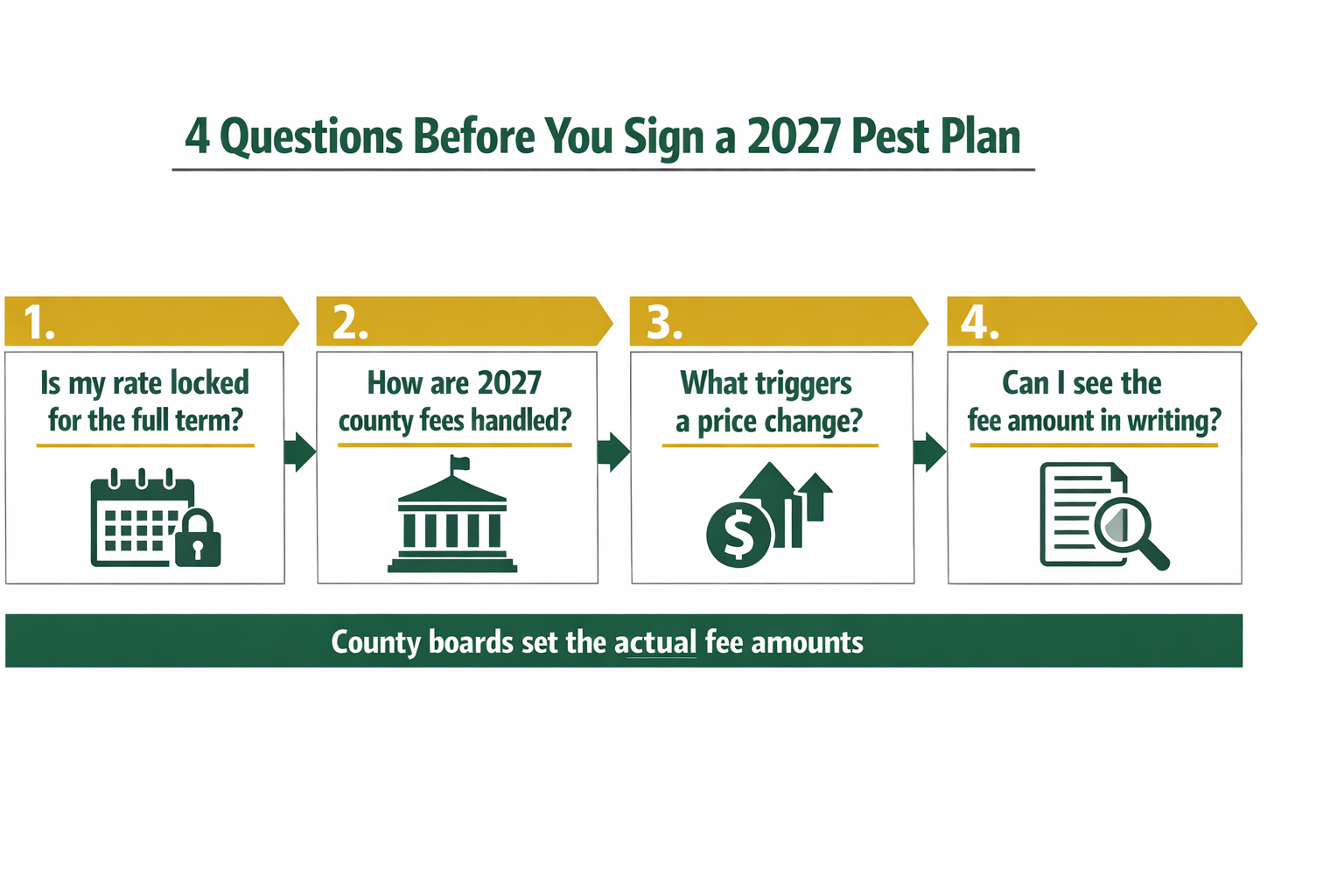
Four questions to ask before you sign a 2027 plan
If you are considering a recurring rodent or ant plan this winter, these are the questions I would ask any company before signing.
If you are signing a multi-year plan right now, ask this first
This is the part that actually changes behavior. If you sign a recurring plan in late 2026 that runs into 2027 or beyond, ask how 2027 county fees are handled before the rate resets.
Three reasonable answers exist, and all of them are fine as long as you hear one of them:
- The rate is locked for the full term regardless of fee changes
- The rate may adjust, and the contract spells out how much notice you get
- Fees are passed through as a separate line item you can see
What I would not accept is a vague “prices may change” clause with no notice period attached. Landlords and small property managers should pay closer attention here, since a per-property plan multiplies any adjustment across a portfolio.
And if you are only dealing with one visible problem, a single targeted treatment may serve you better than a recurring agreement. A fresh ant trail in a kitchen or a wasp nest over a doorway is often a one-visit situation, not a year-long commitment.
What drives your price far more than any registration fee
I will be blunt: county registration is a rounding error compared to the things that genuinely move a quote up or down around here.
The real cost drivers I see in Santa Cruz County homes:
- Crawlspace and attic access. A tight crawl under an older Westside or Soquel home takes real time.
- Severity and how long it has been going. Someone who calls after seeing one roach is a different job than a kitchen with egg casings behind the appliances.
- Follow-up visits. Rodent work almost always needs a return trip to check traps.
- Lot size and vegetation. A ninth-of-an-acre yard versus a near-acre property with heavy ground cover is not the same scope.
- Species identification. Treating the wrong ant gets you a second call in six weeks.
Costs vary a lot, but general market context on the Central Coast puts a simple one-time interior ant or spider treatment in the low-to-mid hundreds, with rodent work running higher because of inspection time and return visits. Those are ranges, not quotes, and the only way to get a real number is a look at your actual property.
Our coastal climate stretches a lot of these jobs. Fog, soil moisture and mild winters keep ants active nearly year-round and push rats toward structures earlier in fall than inland California. I broke the rodent side down further in this look at what moves rat removal costs up or down, and there is a related piece on getting ahead of storm season pest pressure.
One customer put it the way most people feel about this trade: “It was a pleasure dealing with and supporting a local business.” Transparency about a fee change is part of that.
Frequently Asked Questions About the 2027 County Registration Fee Change
Does this mean my pest control price goes up on January 1, 2027?
Not automatically. The law takes effect January 1, 2027, but it only raises what counties are allowed to charge. Your county board of supervisors decides the actual amount, and each company decides whether and how to reflect it in pricing.
How much is the new fee, exactly?
The law sets a ceiling of $75 per year in the home county and up to $50 to register in an additional county. For structural pest control businesses and licensees, the dollar caps were removed and fees simply cannot exceed the county’s actual cost of processing. The specific numbers come from the county, not the state.
Why does a company have to register in more than one county?
Because registration is required with the county agricultural commissioner in every county where the work happens. A company working both sides of the Pajaro River, for example, deals with more than one county office.
I am a landlord with several units. Should I renegotiate now?
I would not renegotiate, but I would read the renewal language. Ask whether your rate is locked for the term and how much notice you get before a change. Multiplying even a small adjustment across six or eight units is worth five minutes of reading.
Does this affect the products used in my home?
No. Registration fees are a business compliance cost and have nothing to do with treatment methods or product selection. Low-toxicity choices around kids and pets are a separate conversation entirely.
Want a straight answer about 2027 pricing?
If a rate notice shows up next year and the explanation feels thin, ask for the actual fee amount in writing. Homeowners and property managers across Santa Cruz County, including the communities right up against the Monterey County line near Pajaro and Las Lomas, are welcome to call (831) 430-8402 or visit westpestco.com with questions about how any of this works. Happy to talk it through, whether or not there is a job at the end of it.