Direct Answer: Raised beds give rats shelter, food, and water in one spot. A hollow base, thick straw mulch, damp drip lines, and ripe produce turn a garden box into prime nesting ground.
A homeowner on the Westside of Santa Cruz reached out this summer with a worry I hear more often than people would guess. He thought he had a few rats in the backyard, then realized they had moved into his garden boxes, and he suspected the way the boxes were built had created the perfect nesting spot.
He was right. Raised beds, planter frames, and stacked lumber are structures, and rats read structures as shelter.
This article stays on the garden side of the wall. If rats are already in your attic or crawl space, that is a different conversation. Here I want to explain what a backyard is actually offering them, how to read the signs out in the yard, and what treatment looks like when there is an edible garden in the mix.
Why Rats Move Into Backyard Garden Boxes and Raised Beds
A rat needs three things in close range: food, cover, and water. Most Santa Cruz raised beds hand over all three inside a four by eight foot footprint.
Here is what I look at first when I walk up to a bed:
- A hollow or open base. Beds built on legs, on pavers, or over an uneven slope leave a void underneath. That void is dry, dark, and protected from hawks and cats.
- A gap between the frame and the soil. Boards shrink and warp in our fog and sun cycle. A half inch gap is an open door.
- Thick straw mulch. Straw holds heat, hides movement, and makes a ready-made nest material pile.
- A drip line that runs all summer. Steady moisture at the soil surface means they never have to leave the bed for water.
- Stacked lumber, pots, or bagged soil beside the bed. Those piles become the staging area between the burrow and the food.
Add ripening tomatoes, squash, strawberries, and sunflower heads, and the yard stops being a place rats pass through. It becomes where they live.
One detail people miss: the problem is rarely the garden alone. It is the garden plus an ivy bank, a fence line, or a woodpile within about thirty feet. Rats want a covered travel route, and a bare lawn crossing makes them nervous.
What Yard Activity Looks Like Before Anything Gets Indoors
Most people call me after they hear something in the wall. The yard gives you a much earlier read if you know what you are looking at.
Walk the perimeter of your beds in the morning when the dew still shows tracks. I look for:
- Worn runways through mulch, ivy, or ground cover, usually two to three inches wide and packed flat.
- Smooth burrow openings at bed corners, against fence footings, or under the slab edge of a patio. A fresh hole has clean, pushed-out soil and no cobwebs.
- Gnawed produce on the low side. Tomatoes and squash chewed where they touch the soil, not on top, usually means ground-level feeding.
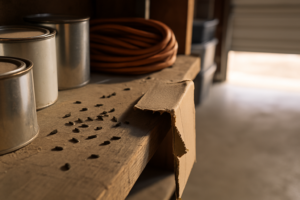
- Droppings in the straw, dark and tapered, often concentrated near the bed wall rather than scattered evenly.
- Greasy rub marks along fence rails, deck joists, and irrigation lines where fur oil builds up on a repeated route.
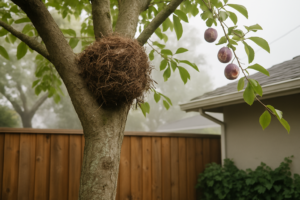
There are two behavior patterns worth knowing, and they change where you should be looking. Ground-level rats burrow under beds, sheds, and along foundations. Climbers work fence tops, grapevines, and fruit trees, and they nest above ground.
I have had a Santa Cruz County resident ask me to remove a rat nest from a tree in the backyard, which is a good reminder that not every nest is underground. If you only inspect at ankle height, you will miss half the picture.
Where to Look Based on What You Are Seeing
This is roughly the mental checklist I run through on a backyard walkthrough.
| What you noticed | What it usually points to | Where to inspect next |
|---|---|---|
| Tomatoes chewed at the bottom | Ground-level feeding from a nearby burrow | Bed corners, under the frame, fence footings |
| Fruit hollowed out high in the tree | Climbing rats working above ground | Tree crotches, fence tops, roof edge, vine cover |
| Droppings in straw mulch | Active nesting or staging in the bed itself | Under the mulch layer, void beneath the bed |
| Flattened paths through ivy | Established travel route between cover and food | Where the path starts and where it ends |
| Greasy smudges on irrigation line | Repeated nightly route along a fixed edge | Follow the line in both directions |
| Dug soil in a potted plant | Water seeking or caching food | Nearby water source, compost, pet bowls |
The Santa Cruz Backyard Rat Calendar
Our coastal climate does not hand rats a hard winter, so the yard stays productive for them most of the year. Here is how the pressure shifts by season.
September and October Are the Window That Matters
Timing here is its own topic because our county does not follow inland California patterns. Late summer and early fall stack the deck: apple, plum, and backyard citrus drop lands on the ground at the same time the vegetable season winds down.
That is a lot of calories sitting in the open. Populations build fast on it.
Then the first real storms arrive, usually sometime in November or December, and that same outdoor population starts testing the garage, the shed, and the crawl space. I have written before about how the first storms of the season act as a cue for rats to move toward anything warm and dry.
So September and October are when yard activity is both easiest to spot and easiest to act on. By the time it is raining, you are no longer solving a garden problem. You are solving a structure problem, and those take longer.
One more local wrinkle. Our fog and mild nights mean there is no hard winter knockdown the way there is in the Central Valley. The yard keeps feeding them nearly year round, which is why I treat fall yard activity as a schedule item rather than a surprise.
Treating Rats Around an Edible Garden
This is the question homeowners actually ask, and it deserves a straight answer. A Santa Cruz homeowner once wrote in about ants after a front yard landscaping job and asked directly whether her organic vegetable garden in back would limit her treatment options. Fair question. Same logic applies to rats.
Working around food crops leans on placement and mechanical control, not broadcast product over beds. In practice that means:
- Snap traps in protected, locked stations set along runways and at burrow entrances, not scattered in the open where a cat or a kid could reach them.
- Positioning based on the actual route, which is why reading runways first matters more than the tools themselves.
- Nothing applied over soil where food is growing.
- A technician telling you exactly what is going where and why before anything is placed.
On bait, I will be blunt. California has spent several years narrowing which anticoagulant rodenticides can legally be used, largely because secondary poisoning of predators became impossible to ignore. University of California guidance on the 2025 rodenticide restrictions lays out what residents can still legally use and why the rules tightened.
In a county full of owls, hawks, coyotes, and outdoor cats, that concern is not theoretical. A poisoned rat does not die in a convenient spot. It dies slowly, out in the open, where something else eats it. That is the main reason I build most backyard rat work around trapping and habitat changes instead.
Honest Expectations: This Is Management, Not a Finish Line
Treating active rats in a yard lowers the current pressure. It does not seal your property off from the neighborhood.
If your lot backs onto a greenbelt, a creek corridor, or a neighbor with an unpicked plum tree, you stay under pressure regardless. Anyone promising you a permanent end to that is selling you something.
What genuinely changes results is the stuff you control:
- Harvest produce as it ripens instead of letting it sit a few extra days on the vine.
- Pick up fallen fruit weekly during the drop, even the mushy ones.
- Move compost into a closed container rather than an open pile.
- Pull ivy and dense ground cover back from the foundation and from the bed perimeter.
- Rethink a bed whose base is open underneath, or at minimum close that void with hardware cloth before the fall.
- Store bagged soil and lumber off the ground and away from the garden.
On the professional side, the part that matters is diagnosis before treatment. Someone should be reading your runways and burrows, telling you whether you are dealing with ground burrowers or climbers, and explaining what is actually happening before anything gets set.
If the activity has already moved past the garden, that is when I start looking at what is drawing them toward the house itself and whether there are signs under the house but not inside yet.
One local customer put the goal pretty well in a review: “he was very confident that we could fix our rat issue without using poison.” That confidence comes from finding the source, not from spraying something and hoping.
Frequently Asked Questions About Rats in Backyard Garden Beds
Does having rats in my garden mean they will get in my house?
Not automatically, but it raises the odds a lot once the weather turns. A backyard population that is comfortable in September is the same population testing your garage and crawl space in December. That is why fall is the useful window.
Can I keep growing vegetables in a bed where rats have been nesting?
Generally yes, though I would clear out heavy nesting material, avoid eating produce with visible gnaw damage, and wash everything well. The bigger fix is closing the void and changing the mulch situation so they do not move back in.
What does backyard rat work typically cost in Santa Cruz County?
Costs vary quite a bit based on lot size, how many beds and structures are involved, whether burrows are active, and how many return visits the situation calls for. Yard work is usually priced differently than interior work because the inspection takes longer. Call for an exact quote on your property rather than trusting a number from an article.
Are those holes under my raised bed from rats or something else?
Rat burrows tend to be smooth, about two inches across, with a packed path leading to them and no fresh soil mound. Other yard diggers leave different patterns. If you are not sure, take a photo in good light and have someone who reads these daily look at it.
Will removing the straw mulch alone solve it?
It helps, but it rarely finishes the job on its own. Straw is the nesting material. The void under the bed and the steady drip line water are usually the bigger draw, and those need addressing too.
Wondering what your own garden beds are telling you?
West Pest Co. is a local, owner operated outfit covering Santa Cruz, Capitola, Soquel, Aptos, and Watsonville, and we are happy to walk a yard and explain what the runways and burrows actually mean. Reach us at (831) 430-8402 or westpestco.com whenever you want a second set of eyes on it.