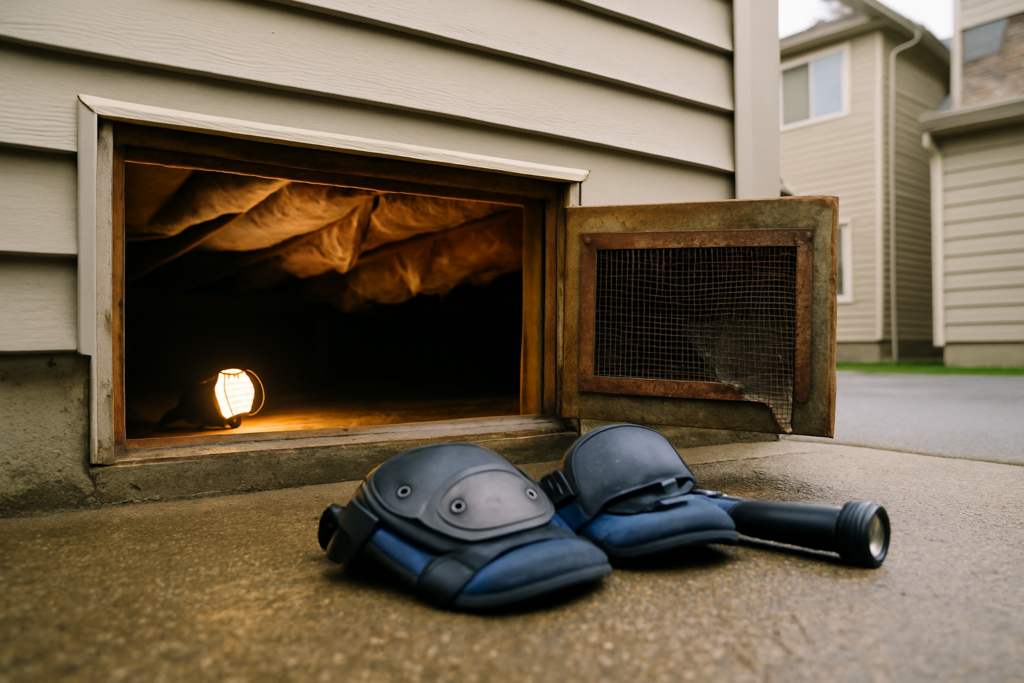
Direct Answer: A mobile home has no real crawl space. Rats that get past the skirting live inside the insulation belly under the floor, nesting in fiberglass and chewing ductwork, not just sitting in dirt.
This summer I heard from two different mobile home owners in the county with the same basic story. Rats under the doublewide, a few things already chewed up, and no clear idea how bad it was down there.
Both of them were picturing a dirt crawl space, like the one under an older site-built house in Seabright or Soquel. A manufactured home does not have one. What it has is a shallow gap behind the skirting and a fabric belly wrap stapled under the floor with insulation packed inside it.
That difference changes everything about where the rats are living, what they are destroying, and what the job to handle it actually looks like. I want to walk through what is really under that floor, what a proper look underneath turns up, and why the trapping and the repairs are two separate line items.
What Is Actually Under a Manufactured Home Floor
Stand at the edge of your unit and the skirting is the only thing you see. Behind it, the structure is built in layers that most owners have never had a reason to look at.
From the ground up, you are usually dealing with:
- Skirting panels, often vinyl or metal, held in a track and easy to pop loose
- A shallow dirt or gravel gap, sometimes only 18 to 30 inches of clearance
- Steel I-beams and the chassis the home sits on
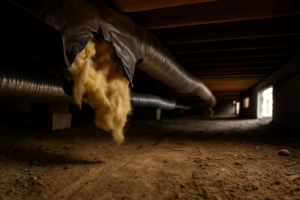
- The belly wrap, a black fabric or poly sheet stapled across the bottom of the floor frame
- Batt or blown insulation held up inside that wrap
- Flexible ductwork for the heat, running through the belly between rooms
- Plumbing lines, water heater connections, and wiring
So a rat that slips past a loose skirting panel is not sitting in open dirt looking for a way in. It is already at the underside of your living space.
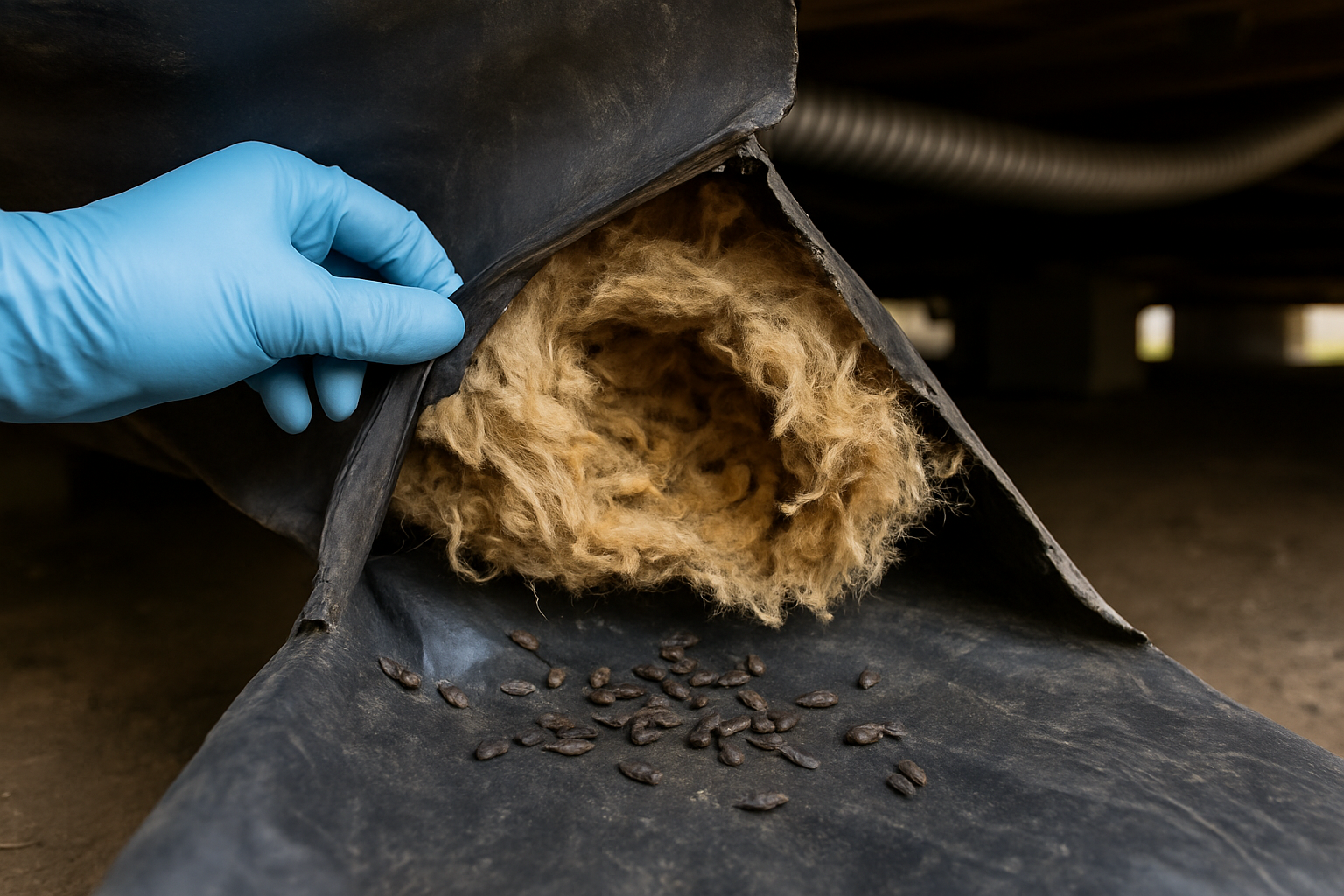
It pushes through a seam or a tear in the belly wrap and it is inside a dry, dark pocket lined with soft insulation it can shred for a nest. The ducts run warm in the winter. Nothing about that space discourages it.
That is also why the sounds carry so strangely in a manufactured home. If you are hearing scratching that seems to move room to room, the sounds coming through the heating vents often trace back to the belly, not the attic.
A Flashlight Peek Is Not the Same as an Inspection
One of the homeowners who wrote in said she had sent a handyman underneath to check it out. He confirmed rats. That was the end of the useful information.
I see that pattern constantly. Somebody goes under, comes back out, says yes there are rats, and the owner is right back where they started with no plan and no idea of the scale.
A real look underneath documents things you can act on:
- Active runways in the dust, worn paths and grease smears along beams and piers
- Where the belly wrap is torn open versus where it is still intact and holding
- Whether droppings are fresh and dark or old, dry, and crumbling
- Which utility penetrations are open: dryer vent, water heater, plumbing cutouts, electrical
- Gaps at the skirting corners, missing vents, and panels that have pulled out of the track
- How much insulation is contaminated and sagging out of the wrap
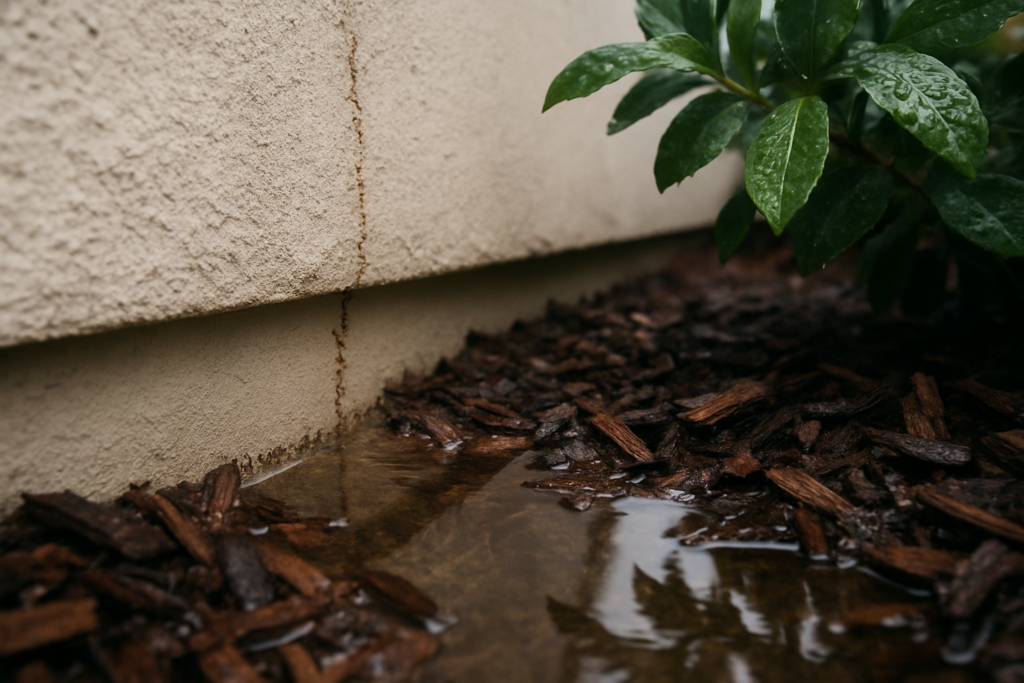
- Whether there is a water source under there feeding the activity
That last set of details is what tells you if you are dealing with a couple of animals that wandered in last month or a nest that has been established since spring.
One customer put it simply in a review: “His inspection found one unknown access point for rodents.” One opening nobody knew about is often the whole story. You do not find it by shining a light in from the edge.
If you have already found droppings inside the home, handling that cleanup safely matters before anything else.
Quick Peek Versus a Documented Under-Home Inspection
Here is the practical difference between someone confirming rats and someone giving you information you can make decisions with.
| What matters under the home | Quick flashlight peek | Documented inspection |
|---|---|---|
| Droppings | Confirms they exist | Notes fresh versus old and which bays are active |
| Belly wrap | Hard to judge from the edge | Maps torn sections against intact ones |
| Runways | Usually missed entirely | Tracks worn paths, grease marks, and travel direction |
| Entry points | Spots the obvious loose panel | Checks dryer vent, plumbing cutouts, corners, and vents |
| Insulation | Looks like a mess | Estimates how much is contaminated or hanging |
| Next steps | None | Trap placement plan plus follow-up visit schedule |
What Actually Drives the Cost on a Manufactured Home
Two of the most common questions I get are what the average cost is to get rid of rats and what pest control charges to remove one. The honest answer is that under-home access swings the number more than anything else.
Trapping the Rats and Closing the Gaps Are Two Different Jobs
One homeowner asked me, almost word for word, how much it would cost to set traps, seal up the holes, and get rid of the rats. That is a fair question and it reflects how most people assume it works: one crew, one invoice, done.
On a manufactured home it rarely works that way, and I would rather be straight about it up front.
The pest side is the active rodent population. That means placing and checking traps in the right spots under the floor, returning to monitor, and judging whether activity has dropped off. That is what I handle.
The structural side is construction work on the shell of the home:
- Replacing cracked or missing skirting panels and resetting them in the track
- Refastening or patching the belly wrap where it has been torn open
- Screening a dryer vent or utility opening that has lost its cover
- Backfilling low spots where the skirting no longer meets grade
That work usually belongs to a handyman or a mobile home repair contractor who works on these units regularly. Paying a pest company and a repair contractor separately is normal here, and it is cheaper than paying one outfit to subcontract the other.
What I would not do is skip the second half. Handling the active rats without ever addressing the openings leaves the home under steady pressure from the shared yards, storage areas, and greenbelt edges that run through most parks in this county. The same thing happens with ants in a manufactured home, where the structure itself keeps handing pests a way in.
What a Number Actually Depends On
I will not throw a dollar figure at a home I have not seen, and you should be careful with anyone who does over the phone.
Rodent work in this area generally starts in the low hundreds for a basic inspection and trap set, and climbs from there depending on conditions. Prices move around by company and by year, so treat that as rough market context, not a quote.
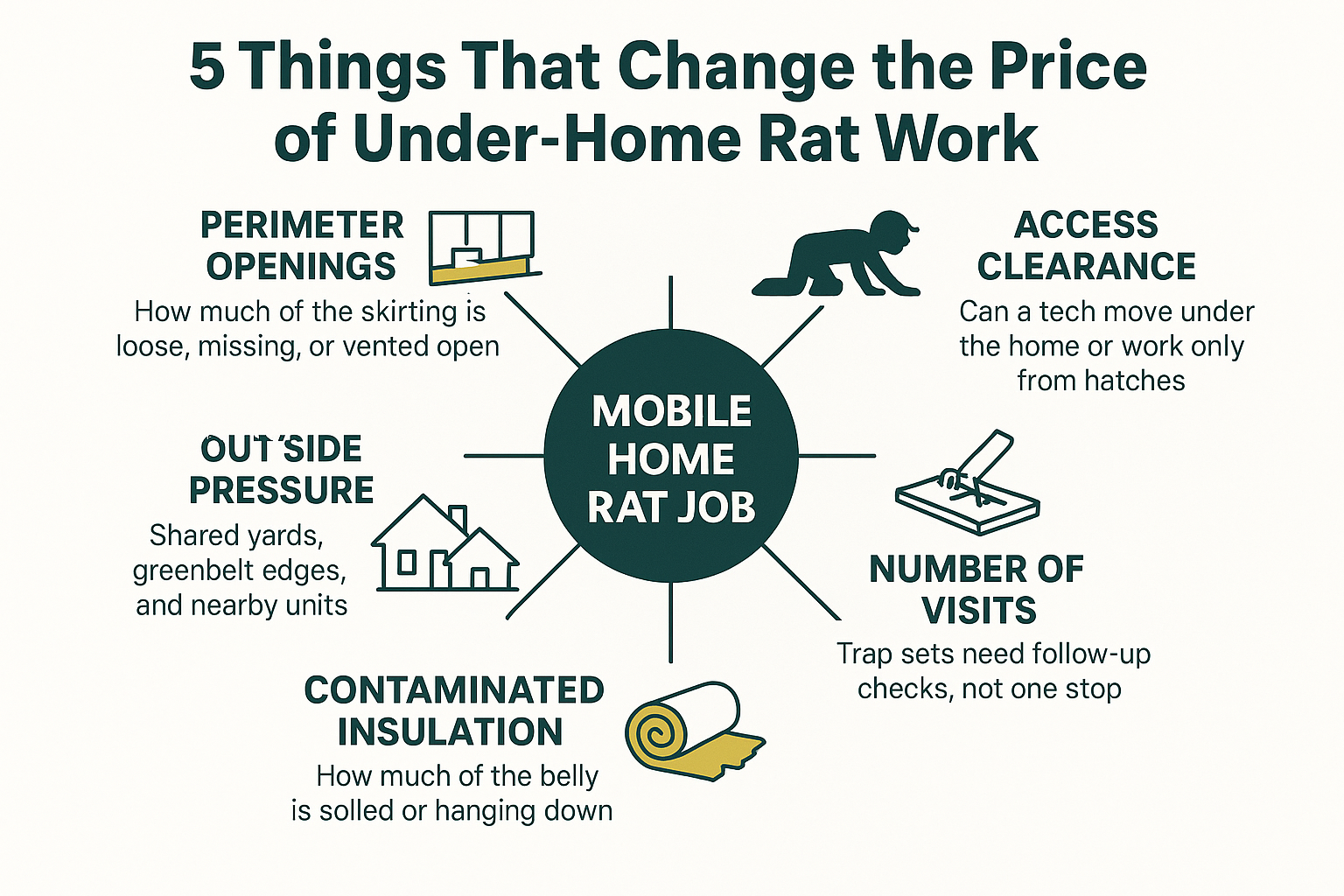
On a manufactured home, the biggest swing factor is whether a technician can physically get under there. A unit with 30 inches of clearance and three open skirting bays is a very different job than one sitting low on a sloped pad with a single access hatch at the back corner.
The other variables you can look at yourself before anyone shows up:
- How many skirting panels are loose, cracked, or gone
- Whether the ground underneath is dry dirt, gravel, or standing damp
- How far the droppings spread across the length of the home
- How many follow-up visits the trap set is likely to need
Most under-home trap sets are not a single visit. Expect at least one return trip, usually within a week or two, because that second check is what tells you whether the activity is actually dropping.
If you want a real figure for your unit, the only way to get one is a look at your specific home.
When the Problem Did Not Start at Your Space
Park living is shared-boundary living. If rats are under your home, odds are decent they are under a neighbor’s too, and nobody wants to pay to solve an entire row.
I see this pattern across housing types in the county. Condo owners, renters, and a homeowner out past Watsonville who was convinced that work on the nearby fields was pushing pests toward the house. The pressure from surrounding property is real, and it does not stop at a property line.
Here is the practical split. The underside of your own home is yours to handle. Common-area conditions are a different conversation.
California’s Department of Housing and Community Development regulates health and safety standards in permitted mobilehome parks, and residents can raise issues through the state’s Mobilehome Assistance Center. The State Senate Housing Committee’s Mobilehome Residency Law guide lays out how that complaint process works.
So if the harborage is in the common areas, it is reasonable to bring it to management:
- Woodpiles and stacked pallets along fences
- Overgrown ivy or brush at the greenbelt edge
- Open storage and uncovered trash enclosures
- Standing water or a leaking common line
What makes that conversation productive is documentation. Photos and written findings from an inspection carry a lot more weight with a park manager than a verbal complaint about rats.
Frequently Asked Questions About Rats Under a Mobile Home
How do I know if rats are in the belly of my home versus just under it?
Look for shredded insulation on the ground and tears in the black fabric wrap overhead. Rats sitting in the dirt leave droppings and runways. Rats in the belly leave fluff falling out of the wrap, and you will usually hear scratching through the floor at night.
Does the insulation have to be replaced?
Sometimes, and sometimes not. If a small section is soiled and the rest of the wrap is intact, a repair contractor can often patch it. If a large stretch has been nested in and is hanging down, replacement is usually the better call. That is an insulation and repair job, not pest work.
Can you just put bait under the home and be done with it?
That is not how I like to work it, especially in a park with pets and kids around. Trapping under the floor gives you something bait does not: you can see what you caught and confirm the activity is dropping. It also avoids an animal dying inside the belly where you cannot reach it.
How long does it usually take to get activity under control?
For a typical under-home set, I expect to be checking traps over a couple of weeks. Older activity with a wide spread takes longer. I will not tell you a single visit solves it permanently, because with open skirting and neighboring units nearby, the pressure does not disappear.
Is this different from rats under a regular house with a crawl space?
Very. A crawl space is open framing over dirt, and you are mostly tracking where they travel and where they get in. A manufactured home gives them an enclosed, insulated layer to live inside. The read on the signs is different too, which is worth understanding if you are comparing it to a site-built crawl space.
Want a Real Look Under Your Own Unit?
Under-home work in a manufactured home is hands-on. It means getting down in the dirt, following the runways, and finding the opening nobody knew about, which is not something anyone can do from the curb. We handle under-home rodent work in mobile home communities across Santa Cruz County, from the coast through Watsonville, and availability is open by phone at (831) 430-8402 or at westpestco.com if you want someone to take a look at your home.