Direct Answer: Rat droppings run about 3/4 inch long, like an olive pit. Mouse droppings are rice-sized. Rats also leave rough gnaw marks and greasy wall smears, and need a quarter-sized hole.
The call almost always starts the same way. Somebody hears scratching in the wall or ceiling, usually after dark or first thing in the morning, and wants to know what is up there.
I get that question constantly from homeowners around Santa Cruz, Capitola, Aptos, and up the hill in Scotts Valley. And it is the right question to ask, because mice and rats are not the same problem.
They climb differently, they enter through different gaps, and they respond to different trapping setups. Here is how I sort it out in the field, and what you can check yourself before anyone comes out.
Mice vs Rats: How to Tell the Difference by Sound Alone
Sound is your first clue, though it is not proof. It still narrows things down fast.
Roof rats, which are the common rat in our county, are mostly nocturnal. If you are hearing heavy scurrying overhead in the ceiling starting an hour or two after sunset, and it runs in long stretches, that pattern fits rats.
Mice move in shorter bursts and are less tied to full darkness. You may hear a few seconds of scratching, then nothing, then more scratching twenty minutes later, sometimes in the middle of the afternoon.
A few other things I listen for when a homeowner describes the noise:
- Where the sound is coming from. Ceiling and upper wall cavity leans rat. Low along a baseboard or under kitchen cabinets leans mouse.
- How heavy it sounds. Rats often make a thump or a roll, not just a tick.
- Whether it moves. Rats travel long runs along a joist. Mice tend to work a small area.
One caller in Capitola described hearing scratching in both the wall and the ceiling, and mentioned she had already caught two mice. That mix is common, and it is exactly why I do not diagnose anything over the phone alone.

Droppings Are the Clearest Evidence You Have
If you find droppings, you have your answer most of the time. Grab a flashlight and check along the back of the pantry, the garage shelves, under the kitchen sink, and the attic edges where the roof meets the wall.
Rat droppings are roughly 3/4 inch long, dark, and shaped a bit like a large olive pit. They are blunt on the ends and there are usually fewer of them in one spot.
Mouse droppings are much smaller, closer to a grain of rice, with pointed ends. You will typically find a lot of them scattered in a tight area, since mice leave droppings almost constantly as they move.
Do not sweep or vacuum a pile until you know what you are dealing with. The CDC and university sources both recommend wetting droppings down and using gloves rather than stirring up dry dust.
Two other field signs worth checking:
- Gnaw marks. Rats leave bigger, rougher damage on wood framing, plastic, and wiring. Mouse gnawing is finer, almost like sanding, often on cardboard and food packaging.
- Grease trails. Rats have oily fur and follow the same route night after night, leaving dark smear marks along baseboards, pipes, and rafters. Mice rarely leave a mark you can see from across the room.
Quick Comparison: Mice and Rats Side by Side
This is the mental checklist I run through on a first inspection. Print it or screenshot it before you go looking.
| What to Check | Mice | Rats |
|---|---|---|
| Droppings | Rice-sized, pointed ends, many in one area | About 3/4 inch, olive pit shape, fewer in one spot |
| Hole size needed | About the size of a dime | About the size of a quarter |
| Gnaw damage | Fine marks on cardboard, packaging, wire coating | Rough, larger damage on wood framing and wiring |
| Grease smears | Rarely noticeable | Visible dark smears along walls, pipes, rafters |
| Activity timing | Short bursts throughout the day and night | Mostly after dark, longer runs of movement |
| Usual location | Lower walls, cabinets, pantry, subfloor | Attic, ceiling, upper walls, roofline |
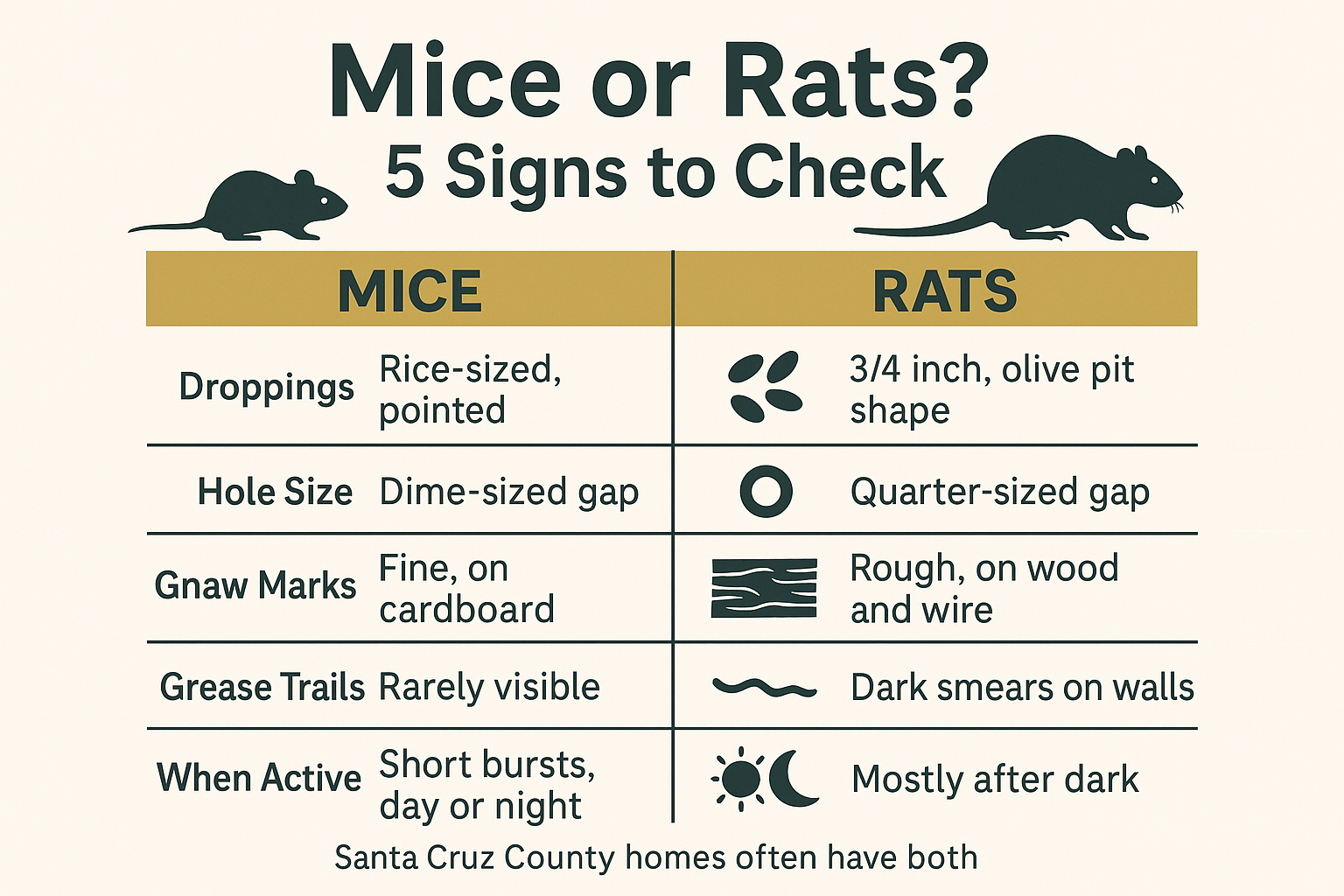
The Five Signs That Separate Mice From Rats
Here is the same information laid out as a quick visual for anyone checking their attic or garage this weekend.
Where They Got In Tells You a Lot
This is the part homeowners usually skip, and it is often the fastest way to identify the species.
Santa Cruz County has a well established roof rat population. They are excellent climbers, and they travel along fence lines, tree limbs, and utility wires before dropping onto a roof. I find their entry points near eaves, roof vents, gaps where a dormer meets the main roof, and around plumbing stacks.
If you have a mature citrus, avocado, or fruit tree touching the house anywhere in Soquel, Live Oak, or Rio del Mar, that branch is a highway.
Norway rats are less common here, but they show up. They burrow instead of climbing, and I see them around compost bins, dense ivy, woodpiles, and older foundations with crawl space vents that have failed.
One homeowner on the West Side described rodents burrowing under the foundation and then getting into the walls. That behavior points at Norway rats, and it is a genuinely different situation than attic activity above a bedroom.
Mice need almost nothing. A dime-sized gap around a dryer vent, a utility line, or a slightly warped garage door sweep is plenty. In older Santa Cruz homes with settled framing, those gaps are everywhere.
If you want the fuller picture on what pulls them toward the house in the first place, I wrote about that in what’s actually drawing rats into your home.
When You Cannot Tell, and What to Say on the Call
I will be straight with you. Sometimes you cannot know for certain without eyes on the attic or crawl space, and in older homes near the coast I occasionally find both species on the same property.
That is not a failure of your detective work. It just means the situation needs visual confirmation.
When you do reach out to anyone, having these details ready saves real time:
- What you hear, including the time of day and roughly where in the house.
- What you found, especially dropping size, and where you found them.
- How long it has been going on. Two nights is a different plan than two months.
- Whether you have already trapped anything, and what kind of trap.
- Pets and kids in the home, since that shapes which products and placements make sense.
Most of the time a rodent inspection in our area is priced as a standalone visit or rolled into treatment, and the range varies a lot with home size, crawl space access, and how much attic there is to walk. Ask for a number up front rather than guessing.
It also helps to know whether you have a handful of visitors or something more established, which I cover in the difference between a rodent problem and a rodent infestation.
Frequently Asked Questions About Telling Mice and Rats Apart
Can mice and rats live in the same house at the same time?
Yes, though rats often push mice out of shared space. In older homes with a crawl space and an attic, I have found rats overhead and mice at the floor level in the same building. Different levels, different food sources.
I caught two mice already. Do I still need someone to look?
Catching a couple is a good sign you identified them correctly, but it does not tell you how many are left or where they are getting in. Mice reproduce fast, so if the scratching continues after a few catches, there is more going on behind the wall.
Does the size of the animal I saw run across the floor tell me anything?
It helps, but young rats get mistaken for mice all the time. Look at the tail and ears instead. Mice have large ears relative to their head and a thin tail. A juvenile rat has a thicker, scalier tail and a heavier body for its length.
Why does the species even matter if I just want them gone?
Because trap size, bait choice, and placement all change. A trap set for mice will not reliably catch a roof rat, and a rat trap set along a baseboard misses mice entirely. Placement matters just as much, since roof rats travel overhead and mice hug the wall line.
The noise stopped on its own. Am I in the clear?
Not necessarily. Activity often quiets down when a nest shifts to a different part of the structure or when an animal dies inside a wall. If you notice an odor a week or two later, that is worth a look.
Still Not Sure What You Are Hearing?
If you have checked for droppings and gnaw marks and still cannot tell, a set of eyes in the attic or crawl space usually settles it in one visit. We work across Santa Cruz County and the wider Monterey Bay area, from the West Side to Watsonville, and same-day availability is often open. Reach us at (831) 430-8402 or westpestco.com when you want a straight answer about what is in the wall.