Direct Answer: On December 31, 2026, private K-12 schools serving six or more pupils count as schoolsites in California. Pesticide timing, permit, and reporting rules near those campuses then match public schools.
If you farm, manage property, or just own a home near a small private school between Watsonville and Las Lomas, you may have heard there is a December 31 pesticide deadline coming. A few people have already asked me if it means they cannot get their house treated anymore.
My read on it is straightforward. For the average homeowner in the Pajaro Valley, this rule changes almost nothing about getting ants or rats handled at your house. It changes real paperwork and timing for growers, permit holders, and operators applying pesticides within a quarter mile of a campus.
The common advice floating around, that everyone near a private school needs to change how they treat pests, is wrong and it is causing unnecessary worry. Below I walk through what the rule actually says, who it binds, and the short list of things worth doing before the end of December.
What the California private school pesticide schoolsite rule December 2026 actually says
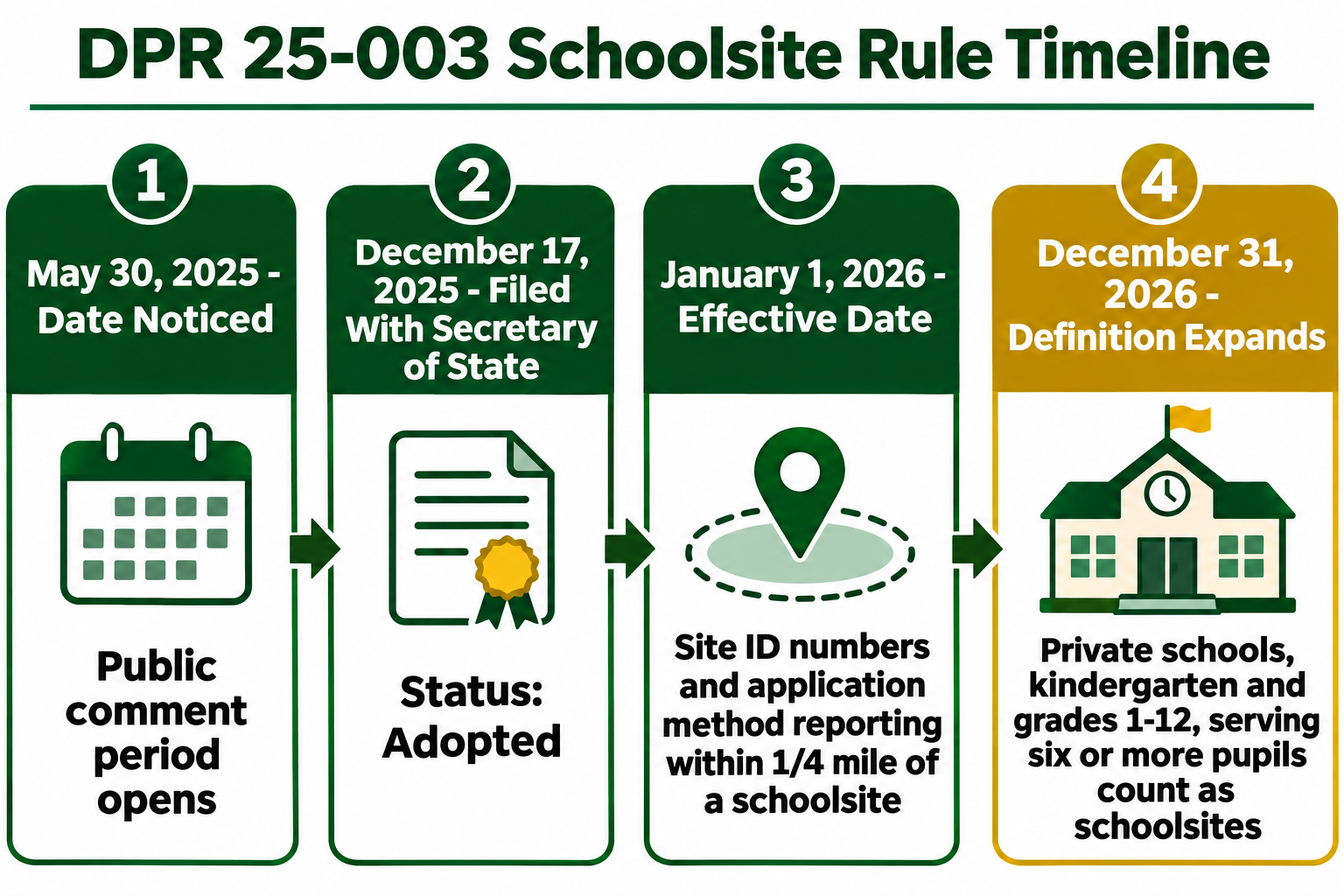
The rule is DPR 25-003, adopted by the California Department of Pesticide Regulation. It was noticed on 05/30/2025 and filed with the Secretary of State on 12/17/2025, with an effective date of 01/01/2026.
One piece of it is on a delay. Per the California Department of Pesticide Regulation, the action “expands the definition of ‘schoolsite’ to include private schools (kindergarten and grades 1-12) serving six or more pupils effective December 31, 2026.”
The rest carries out Assembly Bill 1864 (2024). The Pesticide Applicators Professional Association describes the practical effect this way: for applications within 1/4 mile of a schoolsite, the regulations now require separate site identification numbers for pesticide use reporting, plus application method details in permits and reports.
The adopted language also covers:
- Allowable dates and time ranges during which the application can be applied that comply with the date and time restrictions in 3 CCR section 6691
- Pesticide use reports (PUR) that must include method of application as specified in 3 CCR section 6691
- Separate site identification numbers tied to the ground near each campus
These are the same categories of rules that already apply around public schools and licensed child day care facilities. The change is which campuses count.

Who this touches in the Pajaro Valley, and who it does not
The restrictions in 3 CCR section 6691 sit with agricultural pesticide applications that get permitted and reported through the county agricultural commissioner. That is the world of berry ground, row crops, and the operators who file pesticide use reports every month.
Around here, that matters more than it would in most of California. The flat ground off Highway 129 and the stretch toward Las Lomas and Pajaro puts working fields within a quarter mile of a lot of small campuses, and some of those campuses are private schools with modest enrollment.
So the people who should actually be looking at a calendar right now:
- Growers and farm operators with blocks inside a quarter mile of a private K-12 campus
- Restricted materials permit holders whose permits will need application method details
- Property managers and landowners who lease ground to an operator near one of these schools
- Licensed applicators working that ground on contract
And the people who mostly do not need to change anything: a homeowner in Watsonville, Corralitos, or Royal Oaks who has someone come treat an ant trail in the kitchen or set traps for rats in the attic. Structural pest work inside and around a house is a different category from permitted agricultural use, and the schoolsite date and time restrictions are not written at that kind of job.
Who changes what on December 31, 2026
A quick reference for sorting out whether this deadline belongs on your list.
| Who you are | What changes on December 31, 2026 | Reasonable first step |
|---|---|---|
| Grower or farm operator within 1/4 mile of a private K-12 campus with six or more pupils | That campus now counts as a schoolsite, so date and time restrictions, site ID numbers, and application method reporting apply | Map your quarter-mile radius and call the county agricultural commissioner’s office |
| Landowner leasing ag ground near a small private school | Your operator’s permit and reporting obligations change, not your deed | Confirm in writing that your operator knows the campus is in range |
| Small commercial property manager near a campus | Little to nothing for routine structural pest work | Keep records of what was applied and when, as you already should |
| Homeowner near a private school | No new obligation on you | Ask your applicator what product is used and where, which you can do any time |
| Parent at a private school | Your school moves into the same notification framework public schools already follow | Watch for annual notification material from the school office |
The timeline in four dates
The rule has been moving for about a year and a half, and the piece that matters most is last on the list.
What to do before the end of December if you work ground near a campus
None of this is complicated work. It is mapping and recordkeeping, and the operators who get caught out are the ones who assumed a small private campus with twenty kids did not count.
A sensible order of operations:
- Map the quarter mile. Pull your field boundaries and check them against every private campus nearby, including ones in converted houses or church buildings that do not look like a school from the road.
- Confirm enrollment is six or more pupils. That is the threshold in the adopted language, and it applies to kindergarten and grades 1-12.
- Request separate site identification numbers for the affected blocks so your pesticide use reports line up with the new requirement.
- Update permit language so application method details are in there, not added later.
- Rebuild your application windows around the date and time restrictions in 3 CCR section 6691 before the season gets busy.
On cost, I would not expect anyone to quote you a tidy number. The real expense tends to show up as lost application windows and extra administrative hours, and that varies with acreage and how many campuses sit inside your radius. Penalty exposure for violations is set by statute and handled through the county agricultural commissioner, so the Monterey County office in Salinas is the right place to ask rather than a blog post.
California has been steadily tightening the paperwork side of this trade. The same pattern shows up in the state’s move to disclose which pesticides contain PFAS and in the licensing changes arriving later this decade.
What it means for your house if you live near one of these schools
I get the question in a slightly different form all the time, usually from parents. People want to know what is being sprayed near their kids, their dog, and their vegetable beds.
The honest answer is that this rule gives private school families the same notification framework public school families already had. It does not change what a technician can do at your address.
What I would actually do as a homeowner near a campus:
- Ask your applicator what product goes down, where, and why before anything is applied
- Ask whether the job can be handled with targeted interior work or baiting instead of broad outdoor spraying
- Keep kids and pets off treated surfaces for the window the applicator gives you
- Write down dates, because that record is useful if a problem comes back
Most of the ant and rodent calls I take from Watsonville, Freedom, and Interlaken do not need anything dramatic. Our coastal fog and damp soil keep ants moving almost year round, so the fix is usually finding the trail and the moisture source, not blanketing a yard. Treatment addresses the pests that are active now, and conditions around the home drive whether they come back.
If you are curious how the people doing the spraying get licensed in the first place, there are two changes worth knowing: a new trainee pathway for outdoor-only pest spraying and a rule allowing supervised new hires to spray outside your home starting in 2028.
Frequently Asked Questions About the Private School Schoolsite Rule
Does this mean nobody can treat my house if I live near a private school?
No. The date and time restrictions in 3 CCR section 6691 apply to permitted agricultural applications reported through the county agricultural commissioner. A technician treating ants in your kitchen or setting rodent traps in your attic is doing a different kind of work.
How small can a school be and still count?
The adopted language covers private schools, kindergarten and grades 1-12, serving six or more pupils. Six is the number. A tiny campus in a converted house on a rural road can absolutely qualify, which is why mapping matters more than eyeballing it.
Are preschools and daycare centers included?
Licensed child day care facilities were already inside the existing schoolsite framework before this change. What is new on December 31, 2026 is the addition of private K-12 schools with six or more pupils.
What exactly is the quarter mile measured from?
The 1/4 mile buffer runs from the schoolsite itself. If any part of your application area falls inside that radius, the site identification number and application method reporting requirements come into play. When your block sits right on the line, confirm it with the agricultural commissioner’s office rather than guessing.
I am a homeowner, not a grower. Is there anything I need to file?
No filing on your end. Your only practical job is knowing what is applied at your own property and when, which is a good habit regardless of what school is down the street.
Questions about pest treatment near a Pajaro Valley campus?
Regulatory dates like this one tend to raise more questions about what is happening at your own address than what is happening in the field next door. If you live in Watsonville, Las Lomas, or anywhere along the Santa Cruz and Monterey County line and want a plain explanation of what a treatment at your home would involve, West Pest Co. is reachable at (831) 430-8402 or westpestco.com.